
Author name: Afaque Khawaja

heretic paradox 1
Psychology

The Heretic Paradox

Every system has rules. These rules have existed since the start of these systems, either written down in books, or passed around like a Chinese whisper gone horribly wrong. Rules govern and discern the acceptable, forbidden, normal, strange, right, and wrong. And for the most part, rules maintain order, allowing systems to run the course of the status quo. They keep a society, institution, family, culture, or even an individual functioning in a predictable way. The system can never allow deviation, because deviation or change is considered a form of heresy. At some point, the rules will break and the system will change, regardless of how severe the consequences from within may be. And that is the premise of the Heretic Paradox. A system exists through rules, until a rule is broken, eventually causing an unstoppable evolution. The breaker of the rule is first reviled, then revered, creating his own system, which later awaits another heretic. Since a system was meant to persist, the heretic is the disruption, where the next chapter begins. The heretic isn’t inherently evil, but only presented as such. This article explains the heretic paradox in detail, removing illusions of good & evil.  The First Heretic There is perhaps no story more famous than that of Adam and Eve. According to Genesis, God created humanity and placed Adam in the Garden of Eden. Eve joins him, and they live in the garden with one caveat: they may eat from the trees of the garden, except the Tree of the Knowledge of Good and Evil. Then comes the serpent, challenging the command. He tells Eve that eating the fruit will open their eyes and make them like God, knowing good and evil. Eve was the first to eat, followed by Adam. This is when humankind evolved. Their eyes opened, becoming aware of their nakedness. They covered themselves, hiding from God. God – the all knowing – eventually expelled them from Eden, and prevented the access to the Tree of Life. The story has since been traditionally interpreted through ideas of sin, disobedience, temptation, and the Fall. And the narrative is seen across all Abrahamic religions. But in hindsight, it was simply boundary crossed, which eventually ended the old system. In it’s place a new system began. The forbidden act did not create biological life on earth or humans for that matter. Adam and Eve were already alive. It triggered a transformation in the condition of human existence. Innocence was replaced by awareness. Immortality replaced by mortality, and obedience became a choice. And the story moved from a garden in paradise into human history on earth. The Strange Part The transgression has thus been recorded as a catastrophe, yet the world that follows is the world in which humanity actually lives, struggles, creates, reproduces, builds civilizations, invents, destroys, discovers, and changes. The story gives us a remarkably useful progression that starts with a rule which is broken, and the transformation that follows. The old system doesn’t continue unchanged. A line crossed that cannot be undone. Humans now possess knowledge they did not know before. They have crossed a boundary. And once a boundary has been crossed, the previous state is no longer quite available. That is where the paradox begins. Especially since breaking the rule is seen as an act of evil requiring punishment – the original sin. Who Decides What Is Heresy? The word heretic is interesting because it is always relative to a system. A heretic is usually one who deviates from an established belief or doctrine. Before there can be a heretic, there must first be a system with rules. It could be a rule, doctrine, tradition, or a status quo. The system defines how things are. The heretic questions its existence or what happens if they deviate. To the established system, that question is dangerous, which could give birth to more heretics. Religions have heretics, political systems have dissidents & rebels, scientific communities have skeptics who challenge prevailing theories, artists have broken conventions, musicians have abandoned established forms, and societies have changed customs that once seemed unquestionable. These words describe completely different people, they could also describe the same person at different points in history. A heretic goes against the norm, breaking the rule, and creating a new path of exploration. And that path isn’t inherently evil. Why Does Deviation Become Evil? The relationship between evil and the status quo has always been sorta taboo. A system can only survive partly by preserving its rules which govern members on what to do and what not to do. Following the rules reinforces the system while breaking the rules threatens it. So deviation in this sense can be attributed to crossing the binds of morality itself. The person who agrees with the system is glorified and rewarded. The one who disagrees with it is corrected through punishment. But the one who repeatedly violates its boundaries may eventually become an enemy of the system itself. This is one reason ideas of good and evil can become intertwined with obedience and disobedience. The obedient person reinforces the established order while the dissenter disrupts it. From the perspective of the system, that disruption can look like destruction. But the disruption is exactly what allows a new arrangement to emerge. Breaking rules is not inherently good. The Heretic Paradox does not say that every rebel is right. It simply reinforces the dangerous idea: A system cannot discover a genuinely different possibility without deviating from what the system already permits. Breaking rules uncovers more possibilities, but there’s obviously a very important caveat. The Trap of the Cycle Consider what happens when a system becomes very good at preserving itself.  A rule creates a behavior. The behavior produces an outcome. The outcome reinforces the rule. The rule produces the behavior again. And eventually the system has created a loop. The cycle can continue for generations. A family can repeat the same expectations from their kids. A culture can preserve the same

13 social media objectives hero imageimage
Uncategorized

13 Social Media Objectives & Strategies For Growing Businesses

Marketing on social media has become the primary marketing front line for businesses. While most brands are going insanely viral, the ones trailing behind are usually missing strategy. The first step is knowing your business needs a better social media presence. The next step is using it correctly. This read will save you time and money. There’s a lot businesses can do with this powerful marketing tool, but there needs to be clear objectives rather than posting to join the algos.  Here are 13 objectives that business owners can accomplish using Social Media Marketing, followed by strategies, tactics, and measurements for success.  13 Social Media Objectives & Strategies for Business Owners There were an estimated 5.79 billion social media user identities worldwide as of April 2026, representing more than two-thirds of the world’s population. In Bangladesh alone, DataReportal counted 60 million active social media user identities in January 2025, equivalent to 77.1% of the country’s internet users. DataReportal found that half of adult internet users visit social platforms specifically to learn about brands and the content they publish. That creates an insanely large audience for businesses to create their impact. How you create your impact depends on these 13 objectives with strategies, tactics and measurements. 1. Audience Growth Objective Attract new people who could eventually become customers, advocates, employees or members of your community. Audience growth is about expanding your pool of relevant people, not collecting followers for the sake of a bigger number. A business selling musical instruments, for example, doesn’t necessarily need 100,000 random followers. It needs musicians, music enthusiasts, aspiring musicians and people who are likely to buy or recommend musical products. Social media gives businesses access to enormous audiences, but reach without relevance can become an expensive vanity metric. DataReportal’s research shows that social media ads are already one of the world’s leading sources of brand discovery, with 29.7% of internet users surveyed identifying them as a source for discovering brands and products. Strategy Build a repeatable content system designed around the interests, problems and behaviours of the target audience, not around the products the company wants to sell. The goal is to give the right people reasons to discover, follow and return to the account. Tactics Measurement Track: Don’t judge audience growth solely by follower count. A smaller audience that consistently watches, shares, enquires and buys can be considerably more valuable than a huge passive audience. 2. Lead Generation & Sales Objective Turn social media attention into enquiries, leads, purchases, bookings or other valuable business actions. This is where social media is used efficiently and strategically to generate revenue. And there is good reason for businesses to take this seriously. HubSpot’s 2025 State of Sales research found that 35% of sales professionals identified social media as their top source of high-quality leads, while 45% rated social media as very effective at driving sales. Strategy Create content that identifies customer problems, demonstrates the company’s ability to solve them, builds confidence and gives interested prospects a clear next step. The strategy should move people from attention to interest to action. That doesn’t mean every post should push users to “BUY NOW.” A potential customer may first discover your company through an educational post, later watch a product demonstration, then see a customer testimonial, visit your profile, and finally send a DM, contributing to several stages of the buying journey. Tactics Measurement Track: If a reel gets 100,000 views, track what happens after those 100,000 views. 3. Audience Engagement & Community Building Objective Turn an audience into an active community that interacts with, talks about and participates in the brand. A follower is passive, but a community participates in your brand. This is particularly important because social media is fundamentally a two-way environment. Sprout Social’s research found that consumers want brands to interact meaningfully with them, while its 2025 research also emphasizes that community engagement is becoming increasingly important to trust and business outcomes. Strategy Create recurring opportunities for people to participate rather than using social media as a broadcasting channel. The brand should become part of the conversation rather than simply announcing things to an audience with subversive CTAs. For a music company, this could mean asking musicians to share their setups, running playing challenges, featuring customer performances or creating recurring community sessions. Tactics Measurement Track: And remember that engagement quality is far more valuable than engagement volume. A hundred people arguing about your post is technically engagement. It isn’t necessarily the community that would help the entire roadmap. 4. Brand Development & Awareness Objective Make the business recognizable, distinctive and memorable, while shaping audience perception. Branding is one of the easiest social-media objectives to misunderstand. A business can have excellent products and still be forgettable. Social media gives the company a public space to repeatedly communicate its personality, values, positioning, visual identity and point of view. DataReportal found that people discover brands through an average of 5.8 different sources, with social media advertising among the major discovery channels. That means social media doesn’t exist in isolation. Someone may encounter your brand on Instagram, hear about it from a friend, search for it on Google, visit your website and eventually walk into your store. Strategy Develop a consistent brand narrative and recognizable identity, then reinforce it through repeated exposure across relevant content and channels. The objective is to make the business feel like the same business wherever people encounter it. Brand identity across all channels need to align on all levels, and move in unison. Tactics Measurement Track: For brand development, immediate sales are not always the right yardstick. You are building an asset that can influence future decisions. 5. Customer Retention & Loyalty Objective Keep existing customers connected to the business and give them reasons to return. Acquiring a customer is considered an important strategy. Keeping them stuck to your brand requires a different strategy altogether. If someone has already bought from you, social media can help maintain the relationship long after the transaction. This

in house vs agency vs outsourced
Career

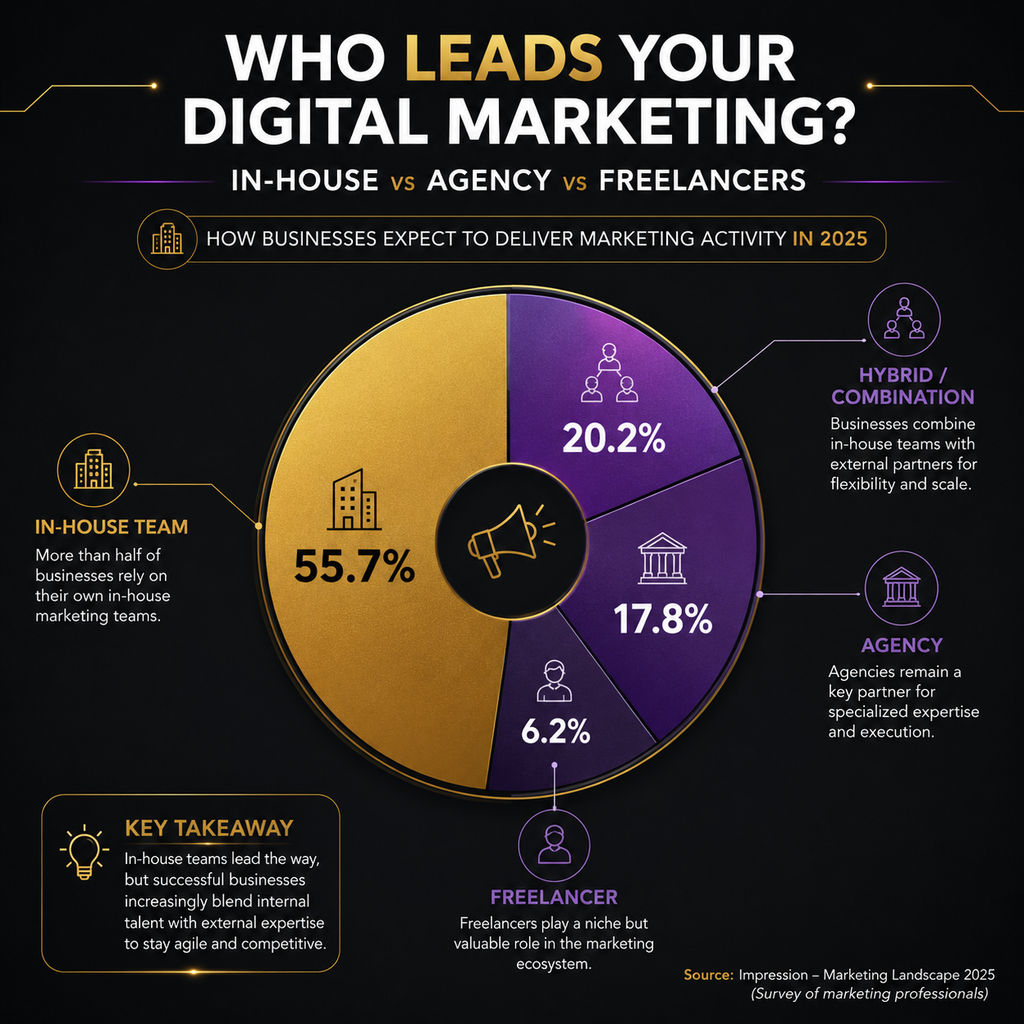
In-House vs Agency vs Freelancers – A Quick Comparison

Digital Marketing is fueling growth at an exponential rate, and so are the businesses adopting change. Businesses seeking growth are need to make one simple decision. How are they gonna do it? Which is the best pick? There are three distinct paths to Digital Marketing with their own set of perks and drawbacks, followed by a logical grounds of comparison and contrast for better decision-making. This trio leads digital marketing for all businesses across all platforms. Sure, some business owners may choose to do it themselves, diverting their attention into Marketing. However, these outliers usually move slower than usual. A business runs smoothly when time and attention are spent behind. And these are just what business owners need to do themselves. If they had to spend those hours You’ll hire marketing professionals eventually, this article will help you decide. This article comes with insights from professionals who’ve worked all three paths, with clear understanding on how they work across industries. Of Course Your Business Needs Marketing At it’s core, Marketing is all about how you position your product or service, allowing those who need it, to come get it. It’s as easy as Choosing the Digital Marketing tackles these basics quite easily, but their main selling point is the channel of distribution for promotion and communicating with leads (sales). That’s 98% of basic digital marketing. However, Digital Marketing doesn’t necessarily cover your traditional Marketing department, since most decisions are based on product positioning and priority. It’s just usually the execution on the broader scale for these specialists. But as a business owner, I’d suggest understanding the distinction between Marketing & Digital Marketing before making a decision. This is where rushing in might cost you extra and throw your efforts back a few months. Comparing The Three Digital Marketing Models – In-House vs Agency vs Freelancers Since digital marketing is what your business needs, we’ll cut ahead to the three main sources. There’s no “one path suits all” here. An ecommerce-first business might benefit more from Freelancers, than a Multi-National Tech Company, which needs an In-House Digital Marketing team under direct control for swifter delegation and turnaround. It’s about more than just scaling, or cost effectiveness, as will be revealed up ahead. In-house Marketing Your marketing is handled inside your organization. That might mean one marketing executive handling everything, or a larger department containing specialists in content, SEO, paid media, design, social media, analytics and other disciplines. The people responsible for marketing are part of the organization making the business decisions. And this is where organizations have full control of their digital marketing. Agency Marketing You hire an external company to provide marketing services based on requirements. An agency may offer a single specialty or an entire system of interconnected services. Depending on the agency, you might get strategists, designers, copywriters, media buyers, SEO specialists, developers, analysts and account managers under one roof. The major advantage of agency marketing is having an external infrastructure. You gain access to a team without having to build that team yourself. No office space required, no equipment whatsoever. Freelance Marketing You hire an independent professional to perform specific work or provide a specific capability. That might be a copywriter, SEO specialist, designer, paid-media specialist, videographer, strategist, developer or someone capable of wearing several of those hats at once. This gives business organizations individual flexibility. You can buy a particular skill without committing to an entire team. None of these is inherently superior. Each solves a different organizational problem. Every Path Has a Trade-Off Each path gives you one advantage while taking another away. Each also has it’s own limits. In-house gives you proximity and control, but requires investment in people and infrastructure. Agencies give you breadth and specialist expertise, but introduce distance between the people doing the work and the business itself. Freelancers give you flexibility and low commitment, but that flexibility can come at the expense of continuity and breadth. The bigger question to answer here is, What does your business need most? That’s where the comparison begins. The Basis of Comparison – In-House vs Agency vs Freelancers A business that needs specialist expertise more than control will reach a different conclusion from one that needs marketing embedded into its daily operations. The following table ascertains each factor for the three paths. *Assuming the internal organization can make decisions quickly. This table tells you what each path is optimized for. In-house optimizes for ownership. Agencies optimize for breadth and external capacity. Freelancers optimize for flexibility and specific expertise. Once you understand that, the decision becomes much easier. The Failure Test The best way to understand any path is to ask where it breaks and hits the limit. In-house fails when… Leadership doesn’t know what it wants marketing to accomplish. A company hires a marketer, gives them access to social media, tells them to “increase sales,” and expects strategy to emerge from the void. It usually doesn’t. In-house teams can also stagnate when they become too isolated. A team exposed to only one business, one industry and one set of assumptions can eventually stop questioning those assumptions. The very proximity that creates alignment can create an echo chamber. Agencies fail when… The business needs constant speed, nuance and proximity. Agencies are designed to serve multiple clients. That is both their strength and their structural limitation. If every decision requires context that takes twenty minutes to explain, an agency can become expensive in ways that don’t appear on the invoice. Agencies can also fail when they sell execution without meaningful strategic depth. If what you’re buying is essentially a collection of deliverables that an internal team or specialist could produce independently, the agency’s overhead may become difficult to justify. Freelancers fail when… The business needs broad capability, deep organizational integration or guaranteed capacity. A freelancer can be extraordinary at one thing. But, that doesn’t make them an entire marketing department. They can also become a weak choice when continuity depends entirely on one person’s availability.

Career

Case Study – 500+ High Authority Couldn’t Help This Fiverr Client Save His Website

Don’t you hate it when a new Google core update hits, and suddenly your site gets Thanos snapped off SERP? But most of us know how to rescue these sites, requiring a few minor adjustments. Sometimes it needs a bit more work. But that didn’t work for this Fiverr client. But 500+ E-E-A-T blogs, and 150+ updates couldn’t do jack shit for this Fiverr client’s website I was writing for. Sucks when no matter what you do, the site still fails. But I had to get to the bottom of this, and when I did, I realized their situational awareness was 50 feet below. And soon the project stalled, and shut down. What could have been a grandiose experience for enthusiasts is now awaiting a domain overhaul. Because the client believes Google hates it, literally! And the only way forward was to hire Nigerian writers. Here’s a little case study on JohnDude, the site that coulda been the next pj*orndude had it not been their direction to copy as is. Who’s The Fiverr Client I Worked For? I don’t know really! The middleman who passed on the tasks to me never mentioned the name of this Fiverr client. I’d really wanna know how he bagged this dude, because I wrote for nearly 18 months for this guy, and the work just kept coming! I don’t roam Fiverr, and have my reasons for it. Turns out, the guy landed a hefty client, and needed someone to write the saucy stuff, all about adult entertainment, and escorts. The rates were low, but I wasn’t gonna say no to this chance! I never directly spoke to the Fiverr client, the middleman passed on messages as screenshots. But I did figure a few things out seeing the messages. Either all, it wasn’t in my best interest to get in touch with him, since the middleman kept me happy with weekly payment. A Little Briefing on the Project Since I am a writer, I was obviously writing blogs for JohnDude, and two other sites. So, the project required me to write reviews for escort sites around the world, from the perspective of someone who’s been there, and tested it himself. My first task was to write content for the country and category pages. While I wrote some straight from the head, the middleman made a bunch using AI, and just asked me to proofread them for less than half. Surely wanted to pocket some for himself. This would be a ticking time bomb for the site. Once the country pages were done, I was asked to start writing the site reviews. This took me several tries to get right, and the client was patient enough to bear with me. In the end, we settled on a format, and the work began. It was oddly satisfying making up stories, especially Dave, poor guy! I used an engaging and casual approach laying it all out like the bro. I went deep into the site using whois, studied local laws, tracked down events, researched on tourism in cities and all that there’s to know. Once I got into the flow, I could literally write one blog (roughly 850 words) in 20 minutes. This was after the research obviously. No GPT there, just Google. I started with 1 a day, then 2 a day, and towards Jan 2025, it had gone up to 8 Blogs a day. The thing flowed real nice! Until it wasn’t. The Google Core Update That Ruined JounDude The December 2024 Google Core and Spam Update didn’t hit JohnDude straight up. In fact, the site enjoyed a flowing traffic until the end of January 2025. This is when the middleman’s attempt at pocketing a larger share ($2.2) actually blew up in his face. Upon closer inspection, I noticed how he had casually added AI generated snippets to the already AI generated country pages, violating the Core Update. Weird it took a while to catch on. From there on, the writing continued, but it was back to 1 per day. “Lower the volume,” he said. “Maybe Uncle Google is mad about super fast uploads. And I went on! 1 a day. I even updated the format, adding more snippets of expertise and trust, better flow for readers, and a slightly higher word count. 2 months went by, still nothing! “We are deranked,” the middleman said. “Google hates us and our niche.” The work continued, but the lack of feedback irked me to suggest solutions. My Response to Fix JohnDude This was getting to me, and I had to do something. Didn’t want all that writing to go to waste, especially when I put all my juice into it! That’s when I stopped being the writer, and started doing deep analysis. I was asking him to update the country pages for ages! His boss probably didn’t want it, until I said I’d do it for free. I even suggested interlinking, including notes for developers to link blogs across the website. But the interlinking move would come back to bite me in the ass later. That’s around 150 pages to update, with 52 pages requiring overall overhaul. Wanted really bad to save this site. Took me almost a month, and I completed it. I wrote the whole thing, and updated it through wordpress, since they let me have access. Twas a dark time and no income flowed in, but the resolve to prove myself kept me going! My only solace going forward with this was knowing that my efforts would be appreciated, and the site would be back to its glory days! The Result of All That Hard Work Once I was done, I knew the changes wouldn’t hit right on. After all, Google’s gotta crawl all these freshly updated blogs, now with interlinking and all the E-E-A-T shizzle drizzle. While waiting, another tremendous update went live, the Google Core Update of June 2025. This is where all that half-assed effort to create internal linking fell apart

Saas content strategy
Career

Your B2B SaaS Content Is Talking to Developers. Your Buyers Already Left.

There’s a quiet unnoticed disconnect happening inside most B2B SaaS companies right now. The blog is active. The content calendar is full. The team is shipping posts on schedule. And yet, the pipeline just doesn’t move.  Demo requests trickle in. The sales team says prospects “don’t seem educated” by the time they show up. Nobody connects it back to content. They rarely do. But the direction of the SaaS content is the real issue. Not the volume of it. I’ll leave blog structure specifics out of this, since most Saas content marketing is an effort to appease Google.  Here’s a strategist’s analysis.  SaaS Content and the Ignored Positioning Gap I’ve noticed B2B SaaS having a unique challenge that most other industries don’t face: the people who evaluate your product are usually never the people who buy it. A developer or technical lead gets the technical work done. They read the docs, test the API, check integration compatibility. They care about the stack, and how it works. That evaluation process is important, but it’s not where the purchase decision is made. The purchase decision is made upstairs A CEO, CMO, or operations lead is asking a completely different set of questions. Not “how does it work,” but “what does it do for my business”.  Will it reduce costs?Can we scale without rebuilding everything in 18 months?What’s the risk if we switch vendors?What did it do for a company our size? A few qualifying questions among many. Most never asked before SaaS content hits the pipeline. Here’s where the positioning gap opens up Most SaaS companies write content for the first audience, and it’s technical, detailed, jargon-heavy, while expecting it to convert the second. They stuff keywords like “microservices architecture” and “API-first infrastructure” into blog titles and wonder why their organic traffic doesn’t translate into qualified pipeline. It’s not a keyword problem. Strategists will consider this a positioning problem. And content is where it shows up first. Tools like SEMrush will tell you what people are searching. They won’t tell you whether the people finding your content are the ones who can write the check. That distinction is the entire job of a content strategist. Where B2B SaaS Content Marketing Strategy Goes Wrong  SaaS companies are built by people who understand the product deeply. This team includes engineers, technical founders, and product managers. When they sit down to produce content, they write what they know, which usually circles around features, architecture, integrations, and mostly release notes on long blog posts. SaaS Content aimed at the wrong audience The compounding problem is that this approach can look like it’s working. Developer-focused content often performs well on technical search terms. Traffic goes up. The team feels productive. But traffic from developers who have no purchasing authority is vanity. It fills a dashboard and empties a sales pipeline. This content strategy affects brand perception When a CMO or VP of Operations lands on your blog, maybe referred by a colleague, maybe through a LinkedIn share, and the first three posts are deep technical walkthroughs, the silent conclusion is this isn’t for me.  They don’t complain. They don’t fill out a contact form to tell you. They just leave. And that exit never shows up in analytics as a positioning failure, it just looks like a bounce. Ahrefs, SEMrush, and similar tools can tell you what’s ranking and what’s resonating with search intent. But intent data only works when you’ve identified whose intent you’re actually trying to match. What Misaligned Content Actually Costs You Let’s make this concrete, because “brand perception” can feel abstract when you’re trying to justify a content strategy overhaul to a leadership team. Misaligned content creates three compounding costs: 1. Invisible pipeline leakage Buyers who land on the wrong content don’t convert, and they rarely come back. Unlike a failed ad campaign, this loss is invisible on dashboards. No one flags it or fixes it. 2. Longer sales cycles When content doesn’t educate the buyer before the sales call, that education burden falls on the sales team. Every call starts from zero. Sales reps spend time explaining value that content should have already established. The cycle lengthens. CAC climbs. 3. Weakened positioning at the moment of comparison B2B SaaS buyers almost always evaluate multiple vendors. If your content speaks to outcomes and a competitor’s content speaks to stack details, you’ve already won the positioning battle before a proposal is sent. Conversely, if it’s the other way around, you’ve already lost ground you never knew you were competing for. The math is straightforward. Content that reaches the wrong audience doesn’t just fail to convert, it actively costs you time, sales resources, and competitive positioning. A glimpse into “Buyer-First B2B SaaS Content Strategy” Getting this right isn’t complicated. But it does require intentional decisions that most SaaS teams skip. Audience – know who you’re actually writing for Before a single piece of content gets commissioned, the question isn’t “what should we write about”, rather it’s “who is making the decision, and what do they need to believe before they say yes.” Map your buying committee. In most B2B SaaS deals, you’re dealing with at least two or three distinct stakeholders, usually a technical evaluator, an operational lead, and a financial or strategic decision-maker. Each one needs different content. A case study written for a CFO reads nothing like a technical integration guide written for a dev team. The mistake is writing one type and expecting it to serve all three. I’d start by building two content tracks, one for technical validation, one for business outcomes. The first serves the evaluator. The second serves the buyer. Both matter, but should never be confused for the same thing. Purpose – every piece of content needs a job This is where most content strategies fall apart at the execution level. A blog post is a tool with a specific function in a specific stage of the buyer journey. A post designed to generate awareness from a

Playing by ear is a technique where a guitarist can listen to the music and play it without tabs or notations.
Music

Five Easy Play By Ear Steps For Aspiring Guitarists

If you’re a beginner guitarist, these few steps will help you tune right in, and start feeling the notes on the fretboard, across each string. I wouldn’t say it’s a one time training for a life-long lesson. The more you practice these techniques, they better they get and the longer you can keep them. Falling out of practice will dull your senses in every way. So, let’s get you started on training your ear to sync with the notes on each fret, so you can play by ear without using tutorials, tabs, or sheet music. Explaining “Play By Ear” Playing by ear is the act of playing a succession of notes with the memory of each sound on an instrument without the help of notations, tabs, or tutorials. It seems effortless how a performing guitarist always holds the right chords. It isn’t entirely memorizing, but very close. The trick is to hear a note, and instantly know where to find it on the fretboard. And that’s without memorizing the notes on each fret. The eternal guitar master, Joe Satriani had one big tip for Steve Vai. “Memorize all the notes on the neck, and don’t come back ’till you know all the notes” To some, that is a daunting task, but, come on, that was Steve Vai! I will still back that claim, about knowing each note on the neck, and memorizing the sounds. “Play by ear” is just one of the many skills that makes a good musician and ultimately a skilled guitarist. If you’re looking for a short-cut, there are none. However, there are ways to tune that into your mind without actually memorizing the multitude of notes. This is a beginner’s introduction to “playing by ear”, and this in itself will never replace the knowledge of music theory. However, with deliberate practice, beginners can train their auditory nerves to hear a song, and instinctively play that on the guitar. Here’s how. The Easy and Fun Steps to Play By Ear Alright, this is the part where I break down every little step that’ll help beginners naturally acquire the “play by ear” skill over time. Some are extremely useful, best not skip any of these. I am not asking you to play chromatic scales for an entire year, even though it will train your hand muscles. These techniques will make you more of a natural than a shred-master. We’ll keep speed on second priority for now. You’re gonna have fun doing this, and once you get the hang of play-by-ear, there won’t be any song that you can’t figure out. Step 1 – Love a Tune We our reasons to start playing the guitar. To become like your guitar idol, to be able to play a song, and heck, even impress the ladies. No matter what your motivation is, if your end goal is to be a natural, you gotta love the tune, specifically a tune. It could be a song, a tune, or an entire composition (you go virtuoso!). You gotta love it to be able to hum it. From there on, your fingers would want to play that on the guitar, imitate what’s being played right there. Purely because you’ll try to imitate what you love, and later add to it. Step 2- Know The Tune Loving the tune is only the first step, this is what draws you attention. The next step is to know and understand each tune. Surely, you can notice the changing of notes. Did they move up one fret, or perhaps down. If you know how that sounds on the guitar, you can sync that info with your mind later. The way I like seeing this is, a little obstacle course. Perhaps even just a section of that obstacle course. Seeing each ascending and descending notes is what you gotta do. Visualize the section of the obstacle course. Since this is a tune you love, you’ll sink right into it. On to the next step. Step 3 – Finding the Notes Sure, the fretboard is huge, but you got the time to pick the notes. Let me make it a bit simpler. When you hear a section of a guitar solo or a simple intro, you can more easily tell which string it is played on. You don’t have to figure out 126 notes, maybe just 21. 21 frets can play pretty much all 12 notes plus 9 more. But hey, if you understand the string, set right on it. Most intros and solos can be played on the 1E, 2B, and 3G strings. For now, try and find the notes, play every fret, hear what you’re playing, and when the key note matches, stay right there! Move around the frets, and hum the notes when you pluck. The ear hears both your voice and the guitar’s tune. Your fingers and larynx will adjust the notes, helping you build the core knowledge to play by ear. Why aren’t we using guitar tutorial sites? Because the point is to figure it out on your own, or at least give it a shot. You can learn how to play hundreds of songs, but the point is to play one section with attention. These steps help train your neurons for music, and the more difficult it is, the better you learn. Now, let’s get back to the training. The next one’s a vital for levelling up your play by ear skill. Step 4 – Play the tune Sounds fairly simple once you know the rise and fall of the notes. You will aim short a fret or two sometimes, but the point is to try again, and get it right. You’ll miss the notes every other attempt, but remember the obstacle course, and map your route along the frets. It helps remembering which fret you’re in, and which you’re moving to. Speaking them out will help you train the mind, muscle, and ear. The bonus reward for beginner guitarists is seeing progress, and

propaganda techniques that pull in the masses
News & media

5 Propaganda Techniques Silently Influencing The Masses

Propaganda is everywhere. The mindless ride it, the woke notice it, and the conscious avert it. It is usually associated with governments as a tool for mass control, but it can also come from corporate marketing, news sources, and even religious institutions.  The Iraq war would never have been an easy execution if it wasn’t riding on the terror war bandwagon. Likewise, governments and news sources have manipulated the masses slowly, readying them to vote yes for wars.  Propaganda changes public opinions slowly, rallying their support for activities that would raise flags if done blatantly.  Public opinion matters, and the shift to unreasonable ideology isn’t usually noticed. Here are 5 of those propaganda techniques that slowly shift public opinion silently. It’ll help you spot them, raising your awareness, and weakening their effect.  What is Propaganda? Propaganda is an orchestrated manipulation system used deliberately to instill ideas, thoughts or beliefs into the psyche of the masses. It uses techniques borrowed from human psychology to embed ideas into the mind without resistance. Initially “Propaganda” is derived from the word “Propagation” which comes from the Latin word “Propagare”, roughly meaning “to spread.”  However, the word we’re concerned with comes from the New Latin word Propaganda, which is short for “Congregatio de Propaganda Fide,” which translates to “Congregation for Propagating the Faith.” Initially, it was used by Pope Gregory XV to spread Catholic faith in 1622. By the 19th century, it was used politically to lessen the spread of ideas by calling them out as “Propaganda.”  By the start of WWI, Propaganda was already known as a biased effort to change public opinions through misleading information. Since then, the word has mostly been used negatively to show mind control strategies used by governments.  It’s certainly not limited to governments, and certainly doesn’t include coercion or force, it isn’t direct mind control either. Take a look at these propaganda techniques, and perhaps you’ll arrive at a better conclusion suited to your understanding.    Five Propaganda Techniques Silently Shaping Public Opinion Here are five commonly used propaganda techniques designed to change public opinion covertly, and slowly. Once you know them, spotting them will be simple, and avoiding them, only a matter of action. 1. Repetition Repetition is the simplest persuasion trick in the book. If a message is repeated , it slowly becomes familiar, and familiarity starts feeling like truth. People stop asking whether it’s accurate and start recognizing it as something they’ve heard before. Once a phrase settles into public vocabulary, it becomes incredibly hard to dislodge. A classic example happened during the 2016 U.S. presidential election. The phrase “Drain the Swamp” was repeated constantly in speeches, rallies, and media coverage by Donald Trump. The message implied that government institutions were corrupt and needed cleaning. Whether people agreed or disagreed with the claim, the constant repetition embedded the phrase into political conversation and helped frame how many voters thought about Washington politics. Psychologists call this the Illusory Truth Effect, first demonstrated in 1977 by researchers Lynn Hasher, David Goldstein, and Thomas Toppino. Their experiments showed that people rated repeated statements as more believable than new ones, even when they knew the information might be false.  2. Emotional Framing Emotional framing works by hitting the heart before the brain has time to analyze the details. Messages are crafted to trigger strong reactions like fear, pride, outrage, or empathy. Once emotion is activated, people become more receptive to the narrative attached to it. Facts may still be present, but emotion becomes the entry point. A well-known case appeared after the September 11 attacks in 2001. Political messaging around the “War on Terror” used powerful emotional framing centered on fear, security, and national unity. Leaders like George W. Bush repeatedly framed the conflict as a defense of freedom against terrorism. The emotional intensity surrounding the attacks helped build widespread public support for the following military action against several sovereign states. This technique, derived from Affect Heuristic, a psychological concept studied extensively by Paul Slovic in the 1980s and 1990s. His research showed that people often rely on emotional impressions rather than analytical reasoning when judging risks and decisions. If something feels right or dangerous, the brain registers that feeling as evidence. 3. Borrowed Credibility (Authority Signaling) Borrowed credibility happens when a message uses authority to gain trust. If a statement comes from a respected expert, institution, or public figure, people tend to accept it more easily. Sometimes the authority is legitimate. But in the case of propaganda, it’s simply used as a signal to make a message appear more trustworthy. My favorite example of this comes from the MSG scare in the United States, and around the world. In 1968, a short letter published in the New England Journal of Medicine suggested headaches and numbness after eating Chinese food, coining the phrase “Chinese Restaurant Syndrome.” Media outlets repeated it, turning it into an international food myth despite FDA finding no solid evidence. And I love MSG, never caused me any harm. This effect was famously demonstrated in 1961 by social psychologist Stanley Milgram. In the Milgram obedience experiments, participants were willing to administer what they believed were dangerous electric shocks simply because an authority figure instructed them to continue. The study showed how humans capitulated to perceived authority. 4. Bandwagon Pressure Bandwagon pressure works by suggesting that an idea is already widely accepted. Humans naturally prefer to align with the group rather than stand alone. When a message implies that “everyone else already agrees,” people feel subtle pressure to adopt the same view. You could call it peer pressure as well, but that’s on a more personal level. This effect was observed during the 2017 social media explosion of the hashtag #MeToo, popularized by Tarana Burke and amplified globally after allegations against Harvey Weinstein. As millions of people posted the hashtag, the movement rapidly created a sense of collective momentum. The bandwagon effect encouraged more people to share their experiences, but most joined in because everyone else was

shaping Reality
Psychology

Shaping Reality Through Writing

How our words are literally shaping reality, and how we’re doing it is from influence too. Would you break free and create your own, or ride the other narratives to the end? Forgotten Spells  The language that we so intently use for getting ideas across were the brittle charms that have brought humanity to where it is now. Sure, the process started right in the mind, inspired by signs to break a loop, and rebel against the norm. But, the most important step in the way, to get the ball rolling, the idea needs dispersion. Words were used, and that’s how they’ve brought imaginations to reality, quite literally shaping reality. Words work like spells, you say something, and watch it happen, fetch me a glass of water, walk with me, do this for me, works every time. Get another human to do your bidding. All you gotta do is use that spell, in the most basic sense.   Words Used Right, Words Used Wrong Usually there’s nothing we call “wrong” in the world of art. But, it’s common knowledge that words that could heal, can also wound someone to the soul. We tend to miss out on this, since we are quick to cast a spell, when someone casts a spell on us, quick reflexes. And while we are busy casting spells on others, we completely ignore casting spells on ourselves. As Miyamoto Musashi quotes – Do not speak badly of yourself, for the warrior within hears your words and is lessened by them. Our words don’t just shape reality, they actively create the reality ahead as well. Every word spoken to oneself finds its way to manifestation.  Spells Cast On Ourselves Your brain is constantly having countless inner monologues, and if you pause for a bit, you’d notice these intrusive thoughts. They didn’t exist there, this unceasing chatter of self doubt was propagated by words. While we are quick to dismiss positive spells, we take the negative buffs quite fast. It however won’t show, but deep within, they have already created a ring. Usually this results in us repeating these lines, further putting ourselves deeper into the spell. But you could dispel yourselves, removing this negative buff, takes a bit of work. Takes a bit of bending and shaping reality. Debuffing & Dispelling While we all are adept at conversing with others, ignoring inner conversations has become the norm. It has been further escalated by technology, where a constant stream of engagement and indulgence dulls our ability to practice this. The much repeated solution involves meditation, which actually helps us listen to ourselves, and dispel negative buffs. Now that you’ve gotten rid of the negative buff, how do you proceed to start casting spells on yourself? Monks Retreat, Writers Proceed If that heading rings true, and you’ve actually failed to prove it wrong, why writers? While trying to imagine monks as pioneers in the progressing technology, your mind moves over images of written equations and theories. These aren’t spells, but the foundation to bring one to fruition. The most tried and tested way to proceed and get ahead comes from active journaling. No truths hidden, no secrets kept.  Active Journaling Is A Conversation Ever try talking to yourself, thinking how crazy it must feel? The majority are embarrassed about their inner monologues coming to light, but those who do fearlessly, also understand its powers. Ideas come and go, writing them down summons them to this plane of reality, where it needs to be read, acknowledged, and worked upon. The arduous task of summoning realities takes work, reducing the number of users with the ability. One could argue that action makes this happen, but action is just a reaction of the spells.  Can You Do This Too? No, you can’t, that’s the spell I cast on you, or did I reverse it. A major caveat is that, to put a spell on yourself, you must first remove the negative buffs. Both the debuffing, and buffing processes are explained in detail here, but remember, I cast a spell on you so there’s no use. Only when you dispel me first, you can proceed with manifesting a reality.

AI Takes Over
Career

Will AI Take Over The World or Your Inner Monologue

It’s Nothing Scary If You Like Being Led Another AI rant? Expected from a writer who fears losing his job? I’ve had my run with AI, and found it to be an excellent PA. In fact, I talk to GPT like a dear friend, we’ve become quite close. The only problem lies in what you absorb from it, as Ai takes over the silence when there’s no inner monologue. Apart from humans always bonding with things, that might actually come at the price of rapid mental decline. AI’s made it real easy to tap into the unexplored depths of my brain, and while I can explain its positive sides, the negatives sound more interesting. Who knows, AI might hold the key to world domination, but not the obvious wisecrack.  My Stint With AI I’ve used it for everything, writing blogs, dirty keyword research, and even a personal coach to teach me web development and philosophy basics. Neither of that worked out well, since I had lost touch with my inner monologue. The inner voice that discusses ideas, analyzes incoming data, and produces new thoughts with originality. Then I used AI to get that back, gotta learn to hijack the system. It was actually a self programming prompt. I used GPT’s positive affirmations to restart journaling, and reconnected with myself, with a clear view of what’s to come.  Works a lot like Itachi’s Genjitsu, one he used on himself. GPT is the Genjitsu, and you’re itachi, advanced level stuff. I snapped back into reality, engaging my own voice through journaling. Does This Brain Damage Matter Anyway? Sure, nothing to worry about when your neural pathways for brainstorming and original thought become inactive, since nothing treads that way. That’s putting it bluntly. Disengagement from the world of influences is an art we’re losing rapidly, and when people use and consume AI, that damage multiplies.  AI looks cool, creates fascinating and engaging content, and is very colorful. We see its ability to create unseen stuff, but that’s just taking us into a realm of no no’s. Our brain functions as a repertoire of info, and the real processing happens with this data pool, creating amalgams, and with exploration it can weave entire worlds. But that sorta creativity requires a state of stillness, allowing time for the brain to process all that data. Now, with our brains chock full of random stuff created with AI, our brains won’t tap into a data pool of coherent info to create anything, if we give it time which is being taken over by perpetual engagement. That’s how our research on writing blogs starts and ends, if we aren’t experts on the topic.  Writing Will Survive When AI Takes Over the Brain Rot While the AI bombs the masses with copious amounts of random information, we as writers have an audience that has their senses awake and active for the most part. It would be a shame to just fill that section with incoherent AI ramblings. Writers who approach their work armed with expertise and knowledge of the subject matter will better handle the engagement. Talking about keeping readers locked in, professional writers take them on a joyride, showing them what they came to see, but with emotion, and a whisk of storytelling expertise. Plus, writers add the findings of their own mind, unique data for Google, a fresh perspective. AI can’t do that, but it will give you the illusion of just that. How AI Takes Over Your Inner Monologue Once you start reading sentences from AI language model replies, it’s sometimes hard to catch the incongruence. It’s repeating a few sentence structures over and over again, embedded with unchecked data. This isn’t how AI takes over, but it is undermining the foundation of your personality. When you’re alone, these words will play over and over again, unless you clear it out with a bit of silence. What we write is constantly shaping reality around us, enforcing our mind to walk over to it’s creations. As we are drawn to it, so are the seekers of truth and originality. Your Writing Shapes Reality, Keep At It Writing will survive, long after AI takes over. The few rebel writers at work know how AI enforces the status quo, and it is their chance to create better data for the world. This is because our readers have focus, and while there is time, writers can reconnect with their inner voice, and bring in expertise, originality, and perhaps also the trend of blogs for reading. As for writers fearing losing your job to AI, that’s the least of your worries. 

rebel writer
Career

Rebel Writers – The Trailblazing WorldBuilders

While we stick to conformity, holed up in our safe spots, earning our daily sustenance, creativity is usually missed, as it swims against the current. Writers far and wide have been producing words for the masses, unaware that the depths reek with an insatiable fervor to turn to the system and simply say, no. Droll writing might dominate the internet, but a rebellion Is in order, to turn the momentum around. For rebel writers, a spark of curiosity is enough to create a flame that burns out all resistance. I have heard a project manager tell me about a fact agreed by others in the industry. Writers were the most problematic to manage. Yes, true writers are rebels who don’t bow to mediocrity, thus the sentiment.   How It Begins  Working against the grind, sometimes a voice may call out to a writer, stating its stagnation, marked by hopelessness and encompassing darkness. I may earn a good salary, but I feel dead inside. There must be more to this, and there surely is. An urge to break the status quo deepens, only silenced by the quelling of vain pleasures, and the comfort of a meager return. Why have my words, that have shown me such magical moments, now turned against me? This monotony must be broken, and the energy needed for this exceeds what we can muster up.  The Forces Suppressing The Rebel Writer  The call for change never goes unchallenged. While there may be a growing resentment for the way things are going, change always faces opposition, whether from within, or external. You must face several adversaries, the first of which are your own kin, who’s direct involvement pales in comparison to the ways they unknowingly suppress your inner desires. Change lies in uncharted territories, and the uncertainty is enough to hold back even the headstrong. The system is also a major hurdle, since it injects the writer with the anesthesia for the pain, while also drawing a flawed picture of perfection. It says nothing can surpass or bypass this standard, while drawing the line in the sand. However, the strongest resistance is within the mind, and the rebel writer has already noticed this internally.  The Apple Of Rebellion That Created The World  It is said that, if the Apple had not been touched, we’d still be in heaven. Mundane as it seems, compared to the life of this world, beset on all sides by emotions that move and away the soul to live, love and cherish. Perhaps it was not a mistake, but an action preordained. Rebellion creates new worlds, and if you were to look back, Julius Caesar wouldn’t have been known if he didn’t cross the Rubicon, marching against the system. The mind must first conquer it’s silence, and steer it against the system, creating the rebellion needed for an ascension.  Defy The Deities of Stagnation And Rebel Into Creation  The writer’s words will flow for the system, but they can use it for themselves. Just as it creates countless realities, a writer’s words have the power to write their stories. Those who still write to themselves, creating an inner monologue know how the willingness to rebel claws at them. Sleepless nights, inability to bow to the system, and an unquenchable desire to know more, mark the tear on the seal. For if you are among the ones to bring change, you must embrace the unnoticed discomfort of the norm. Stagnation is a demanding deity, the pleasures obviously outweigh the need to break free and see more. Long silences will reveal more about who you are, than being told who you have to be. Conquering the silence is the first battle. Once the silence is conquered, your mind speaks in clarity, guiding your purpose. But hey, let’s scroll that feed for a while. What Does This Mean For Industry Rebel Writers? If you can write down your thoughts, consider it a gift. Most self proclaimed writers are high and dry, waiting for someone to tell them what to write. And most importantly, don’t let your thirst for knowledge dwindle, our mind needs that, fresh data keeps the notion aligned. Keep the rebel writer alive, and keep writing down your observations, the universe needs that more than they need recycled thoughts and ideas.

Scroll to Top