
Propaganda is everywhere. The mindless ride it, the woke notice it, and the conscious avert it. It is usually associated with governments as a tool for mass control, but it can also come from corporate marketing, news sources, and even religious institutions.
The Iraq war would never have been an easy execution if it wasn’t riding on the terror war bandwagon. Likewise, governments and news sources have manipulated the masses slowly, readying them to vote yes for wars.
Propaganda changes public opinions slowly, rallying their support for activities that would raise flags if done blatantly.
Public opinion matters, and the shift to unreasonable ideology isn’t usually noticed. Here are 5 of those propaganda techniques that slowly shift public opinion silently. It’ll help you spot them, raising your awareness, and weakening their effect.
What is Propaganda?

Propaganda is an orchestrated manipulation system used deliberately to instill ideas, thoughts or beliefs into the psyche of the masses. It uses techniques borrowed from human psychology to embed ideas into the mind without resistance.
Initially “Propaganda” is derived from the word “Propagation” which comes from the Latin word “Propagare”, roughly meaning “to spread.”
However, the word we’re concerned with comes from the New Latin word Propaganda, which is short for “Congregatio de Propaganda Fide,” which translates to “Congregation for Propagating the Faith.”
Initially, it was used by Pope Gregory XV to spread Catholic faith in 1622. By the 19th century, it was used politically to lessen the spread of ideas by calling them out as “Propaganda.”
By the start of WWI, Propaganda was already known as a biased effort to change public opinions through misleading information. Since then, the word has mostly been used negatively to show mind control strategies used by governments.
It’s certainly not limited to governments, and certainly doesn’t include coercion or force, it isn’t direct mind control either. Take a look at these propaganda techniques, and perhaps you’ll arrive at a better conclusion suited to your understanding.
Five Propaganda Techniques Silently Shaping Public Opinion
Here are five commonly used propaganda techniques designed to change public opinion covertly, and slowly. Once you know them, spotting them will be simple, and avoiding them, only a matter of action.
1. Repetition

Repetition is the simplest persuasion trick in the book. If a message is repeated , it slowly becomes familiar, and familiarity starts feeling like truth. People stop asking whether it’s accurate and start recognizing it as something they’ve heard before. Once a phrase settles into public vocabulary, it becomes incredibly hard to dislodge.
A classic example happened during the 2016 U.S. presidential election. The phrase “Drain the Swamp” was repeated constantly in speeches, rallies, and media coverage by Donald Trump. The message implied that government institutions were corrupt and needed cleaning. Whether people agreed or disagreed with the claim, the constant repetition embedded the phrase into political conversation and helped frame how many voters thought about Washington politics.
Psychologists call this the Illusory Truth Effect, first demonstrated in 1977 by researchers Lynn Hasher, David Goldstein, and Thomas Toppino. Their experiments showed that people rated repeated statements as more believable than new ones, even when they knew the information might be false.
2. Emotional Framing

Emotional framing works by hitting the heart before the brain has time to analyze the details. Messages are crafted to trigger strong reactions like fear, pride, outrage, or empathy. Once emotion is activated, people become more receptive to the narrative attached to it. Facts may still be present, but emotion becomes the entry point.
A well-known case appeared after the September 11 attacks in 2001. Political messaging around the “War on Terror” used powerful emotional framing centered on fear, security, and national unity. Leaders like George W. Bush repeatedly framed the conflict as a defense of freedom against terrorism. The emotional intensity surrounding the attacks helped build widespread public support for the following military action against several sovereign states.
This technique, derived from Affect Heuristic, a psychological concept studied extensively by Paul Slovic in the 1980s and 1990s. His research showed that people often rely on emotional impressions rather than analytical reasoning when judging risks and decisions. If something feels right or dangerous, the brain registers that feeling as evidence.
3. Borrowed Credibility (Authority Signaling)
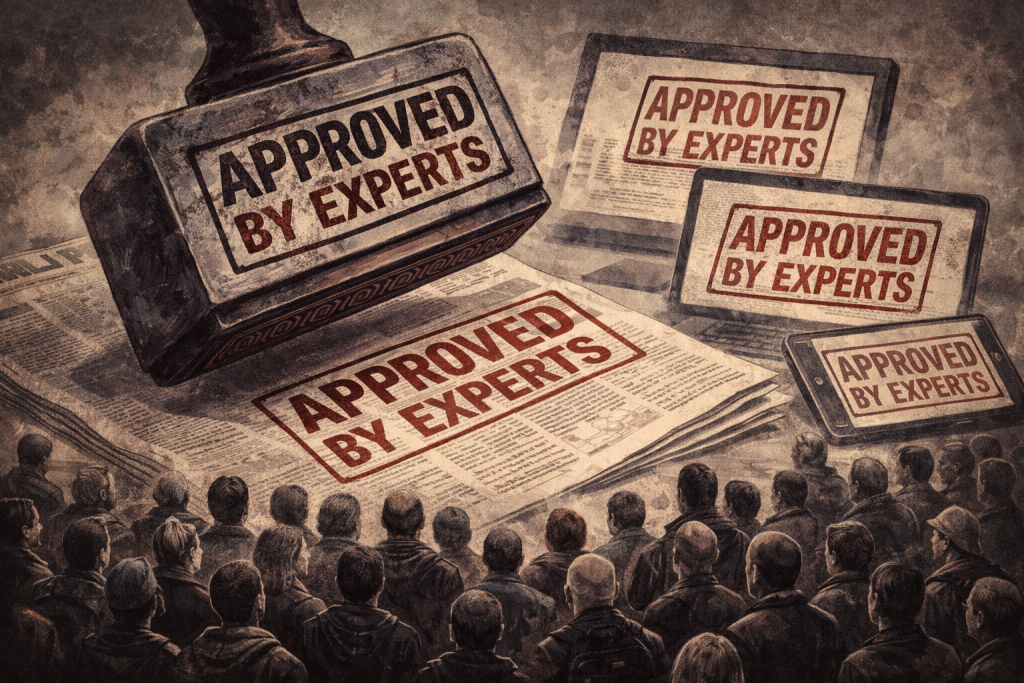
Borrowed credibility happens when a message uses authority to gain trust. If a statement comes from a respected expert, institution, or public figure, people tend to accept it more easily. Sometimes the authority is legitimate. But in the case of propaganda, it’s simply used as a signal to make a message appear more trustworthy.
My favorite example of this comes from the MSG scare in the United States, and around the world. In 1968, a short letter published in the New England Journal of Medicine suggested headaches and numbness after eating Chinese food, coining the phrase “Chinese Restaurant Syndrome.” Media outlets repeated it, turning it into an international food myth despite FDA finding no solid evidence. And I love MSG, never caused me any harm.
This effect was famously demonstrated in 1961 by social psychologist Stanley Milgram. In the Milgram obedience experiments, participants were willing to administer what they believed were dangerous electric shocks simply because an authority figure instructed them to continue. The study showed how humans capitulated to perceived authority.
4. Bandwagon Pressure
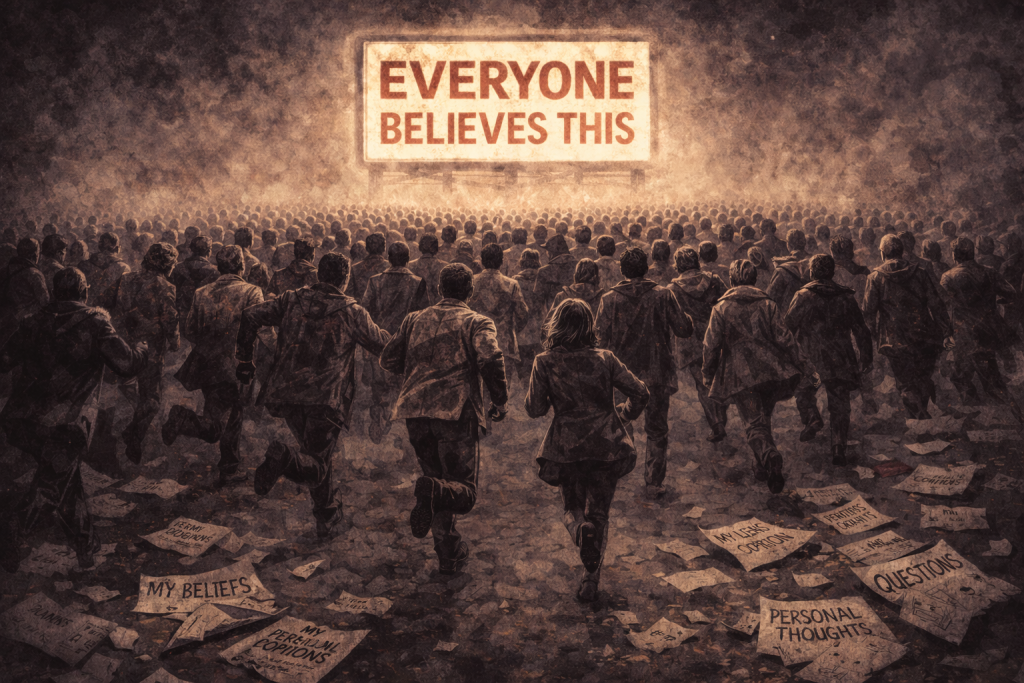
Bandwagon pressure works by suggesting that an idea is already widely accepted. Humans naturally prefer to align with the group rather than stand alone. When a message implies that “everyone else already agrees,” people feel subtle pressure to adopt the same view. You could call it peer pressure as well, but that’s on a more personal level.
This effect was observed during the 2017 social media explosion of the hashtag #MeToo, popularized by Tarana Burke and amplified globally after allegations against Harvey Weinstein. As millions of people posted the hashtag, the movement rapidly created a sense of collective momentum. The bandwagon effect encouraged more people to share their experiences, but most joined in because everyone else was doing it.
The psychological roots of this phenomenon go back to the 1951 Asch conformity experiments by Solomon Asch. In his famous studies, participants were willing to give obviously incorrect answers to simple questions just to match the group’s response.
5. Simplification

Simplification reduces complicated matters into short, memorable messages. Complex debates involving economics, policy, or science are boiled down to a single phrase easy to remember and repeat. It often highlights the triggering points, leaving out the nuances that shift the message altogether.
A clear example appeared during the 2016 Brexit referendum. Supporters of leaving often used the slogan “Take Back Control.” The phrase condensed a complicated debate about sovereignty, trade, immigration, and law into three simple words. The simplicity made it powerful and widely repeated.
This technique reflects ideas studied by Daniel Kahneman and Amos Tversky in their research on cognitive heuristics in the 1970s. According to their study, the brain prefers simple explanations and quick mental shortcuts when dealing with complex information. When an issue is simplified, it becomes easier for people to process and remember, despite the missing counter arguments.
Who’s Using Propaganda?
Initially, it was used by the Catholics, then by governments to pursue war or enforce unethical laws. Now, any organization trying to influence public perception at scale can use persuasive communication techniques.
Here are some prominent users of propaganda with examples.
Political Campaigns
Political campaigns regularly use persuasive messaging to align voter perception. Repetition of slogans, emotionally charged issues, and simplified narratives help candidates build support quickly.
For example, campaign phrases like “Make America Great Again” or “Take Back Control” become powerful through repetition and emotional framing. In reality, there are inflated claims of misleading information.
Corporations
Propaganda is also used by corporations to shape consumer perception of their products or services. This is done through repetitive advertising, sometimes with borrowed credibility.
For example, Coca-Cola’s “Open Happiness” campaigns rarely focus on the drink itself, instead associating the brand with joy, friendship, and shared moments.
Activist Groups
Activist organizations rely heavily on emotional imagery and powerful slogans to mobilize public support for a certain cause.
The “Save the Whales” campaign in the 1970s used striking images of whale hunting to generate global outrage and policy pressure. More recently, environmental campaigns like
Media Outlets
Media organizations influence perception through framing, repetition, and emphasis. News organizations are heavily watched, thus creating a stream of recipients already open to the narrative. The choice of headlines, repeated terminology, and selective focus can strongly influence how audiences interpret events.
During the early stages of the 2003 Iraq War, several major outlets repeatedly used phrases like “weapons of mass destruction,” reinforcing a narrative that shaped public opinion in many countries.
Governments
Governments have historically used propaganda during crises to shape national behavior and gain their support with messages combining patriotism, repetition, and authority to influence millions of people.
During World War II, the United States produced posters encouraging citizens to buy war bonds and conserve resources, while Britain used slogans like “Keep Calm and Carry On” to maintain public morale.
Influencers and Public Figures
In the social media era, influencers can amplify persuasive messages rapidly. When major personalities promote products or ideas to millions of followers, their credibility creates instant authority signaling.
For instance, celebrity endorsements of cryptocurrency or fitness supplements have repeatedly driven large waves of public interest and buying behavior, most of which were later reported as scams.
Religious Institutions
Religious institutions were the first to use these techniques long before modern political propaganda existed. Repetition through sermons, authority through clergy, and community pressure through shared belief systems make religious settings powerful environments for shaping behavior and opinion. Because the message is tied to faith and moral duty, followers often accept it without questioning the source.
In mosques, churches, and temples, key teachings are repeated weekly while delivered by respected authority figures. Over time, repetition of specific interpretations can influence social attitudes, political positions, and community behavior across entire populations. Considerably my initial field of interest, unveiling the supposed mass hypnosis.
Common Propaganda Proliferation Channels (h2)
So how does it all travel? Here’s a quick overview of where your subconscious might brush up against propaganda content.
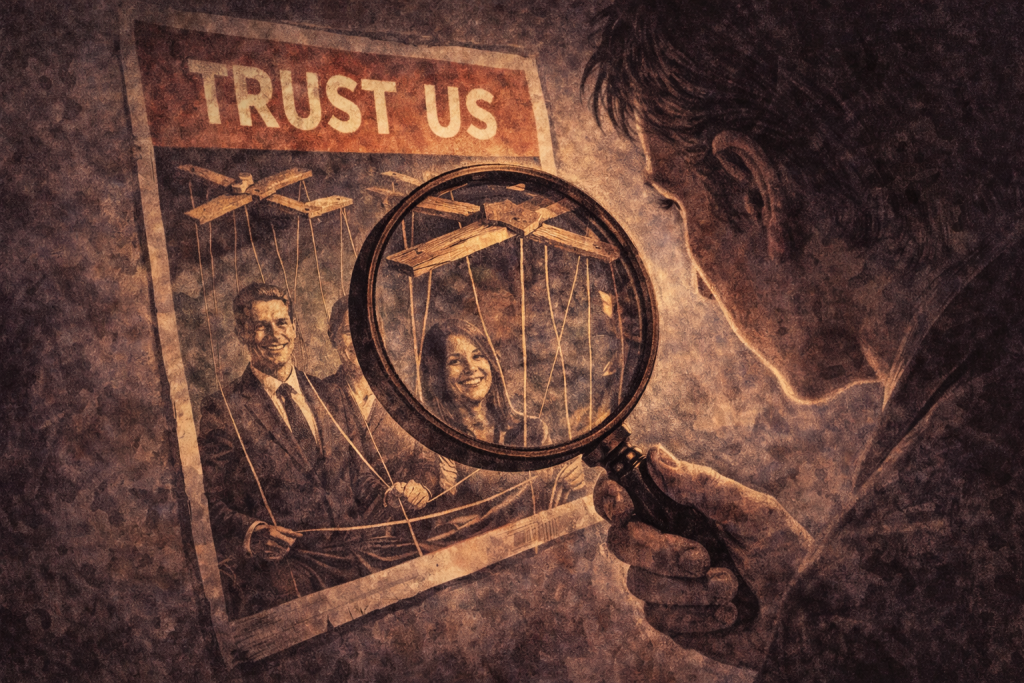
Television & Broadcast Media
Television delivers propaganda with built-in authority. Anchors, studio sets, and expert panels create the impression of verified truth. Repeated framing across daily broadcasts gradually normalizes the narrative. This is still prominent, despite the popularity of social media.
Social Media Platforms
Social platforms accelerate propaganda through algorithms and engagement loops. Content spreads through shares, memes, and trending hashtags faster than traditional media ever could. The more people react, the more the system pushes it further. Despite the lack of authority behind the propaganda, users are still likely to accept the message.
Newspapers & Online Journalism
News outlets influence perception through headline framing and editorial emphasis. What gets highlighted, ignored, or repeated subtly guides public interpretation. Over time, those narratives become the “recorded version” of events. The truth comes from comparing articles across multiple sources.
Films & Entertainment Media
Movies and shows embed ideas inside storytelling. Audiences absorb cultural or political messages while believing they’re just watching entertainment. Over time, repeated themes shape how societies see heroes, enemies, and history.
Billboards & Outdoor Advertising
Billboards rely on simple slogans seen repeatedly during daily routines. Even a short phrase becomes familiar when encountered dozens of times a week. Familiarity quietly turns messaging into assumed truth.
Education Systems
Schools control how people understand history, identity, and authority. Textbooks and curricula can emphasize certain narratives while leaving others out. Ideas learned early tend to remain influential for life. This is why educational systems create a certain “type” of people.cThe proof is in observation.
Influencers & Celebrity Endorsements
Public figures spread narratives to audiences that already trust them. Followers often mirror their opinions blindly. A single endorsement can push an idea deep into online communities. Over a period of time, their word becomes the truth.
Awareness and Immunity

Propaganda works best when people don’t realize it’s happening. The moment someone begins spotting the patterns like repetition, emotional hooks, or authority signaling, the spell weakens. Awareness does not entirely eliminate persuasion, but it slows down automatic response or acceptance.
Pause before you react. Ask simple questions. Who benefits from this message, what emotion is it trying to trigger, and why is it being repeated so aggressively? Those questions alone can expose the mechanics behind the message.
No one is completely immune, but people who understand the techniques are far less likely to accept narratives without examining them.
Why Even Smart People Fall for Propaganda

Intelligence alone does not deflect propaganda. Because it targets psychological shortcuts every human brain relies on, regardless of education or critical thinking ability. When information arrives quickly and subtly, the mind often chooses the easiest explanation.
Another reason is information overload. Modern media environments push hundreds of narratives daily, leaving people little time to verify everything they hear. Even analytical thinkers sometimes rely on trusted sources or social consensus to filter what they believe.
Lastly, propaganda often aligns with existing beliefs. When a message confirms what someone already suspects or wants to believe, skepticism drops and acceptance becomes much easier.
Signs You’re Being Influenced
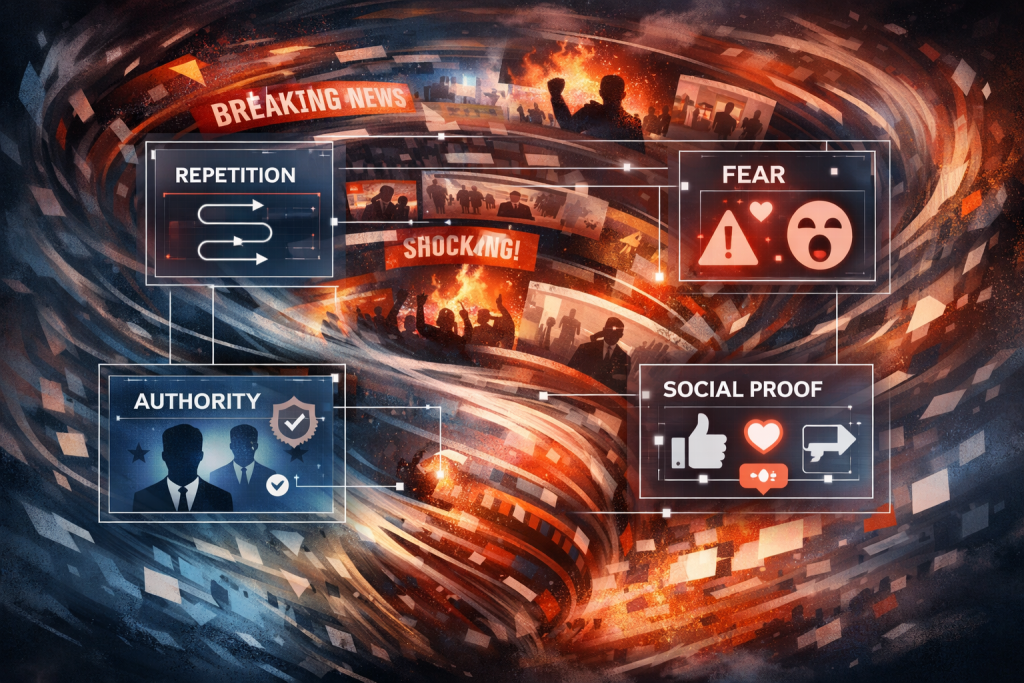
The first warning sign is obviously having a strong emotional reaction to a message. If a message instantly triggers anger, fear, pride, or outrage, there is a good chance the emotional response was deliberately engineered.
Another warning sign is extreme simplicity. Complex issues suddenly presented as one obvious answer or slogan are often attempts to compress complicated realities into persuasive sound bites.
Getting Ahead of the 90%
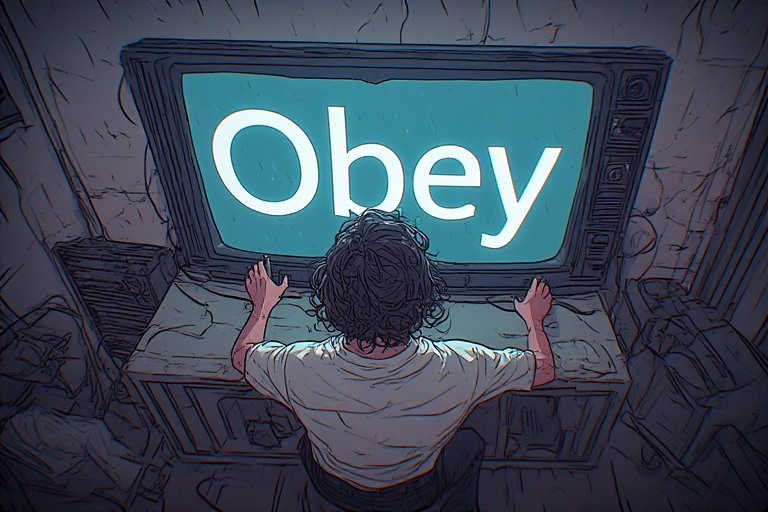
Let’s just say propaganda controls the world. The majority pushing acquired ideas and messaging lack critical thinking, and foundational knowledge of what it is. Despite that, their lack of will to break conformity keeps them there.
But that’s just how the world works. There are opposing forces trying to get their word across, just to garner support and momentum for their cause. I set out with a mind to prove everything wrong, even my own core beliefs, thus here I stand.
My aim is to educate the masses, and expose the architecture behind the grand scheme. Because, once you understand the inner workings, you’ll become unbreakable.