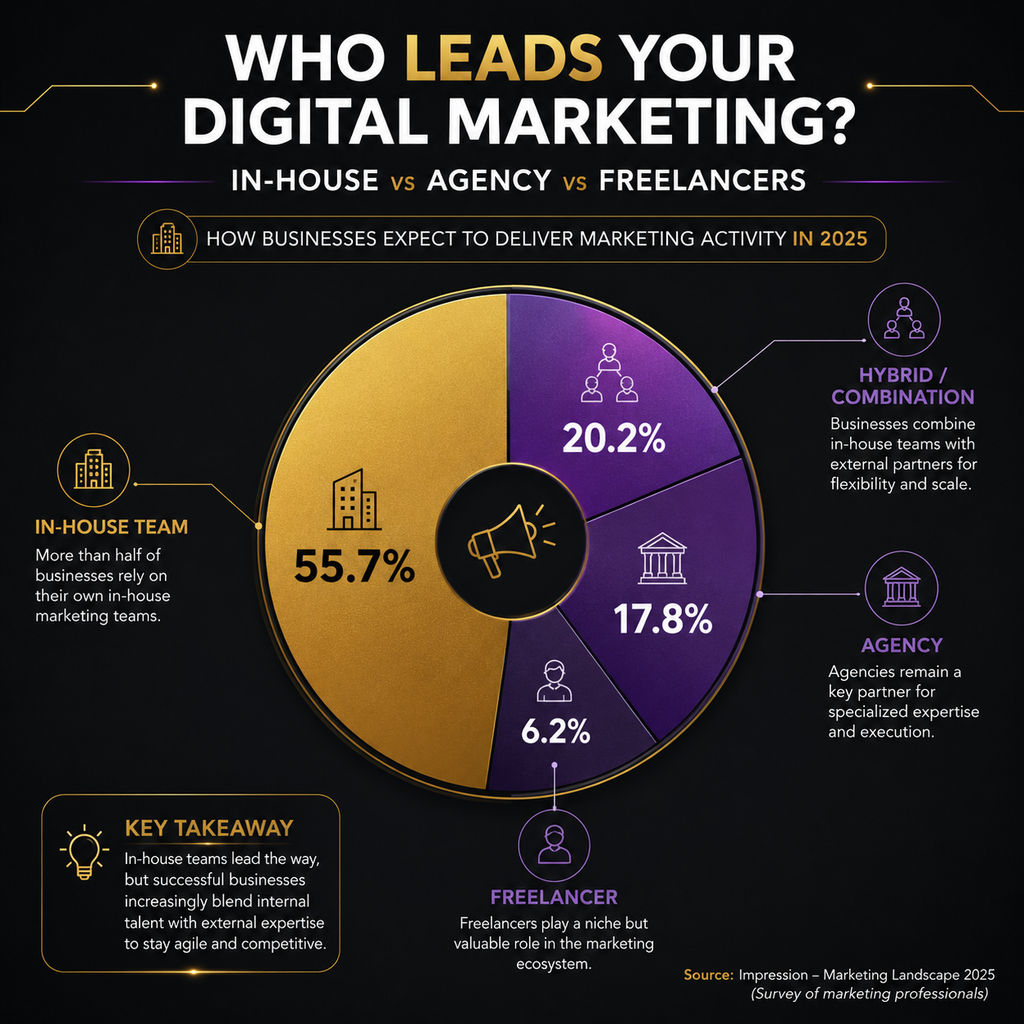
In-House vs Agency vs Freelancers – A Quick Comparison
Digital Marketing is fueling growth at an exponential rate, and so are the businesses adopting change. Businesses seeking growth are need to make one simple decision. How are they gonna do it? Which is the best pick? There are three distinct paths to Digital Marketing with their own set of perks and drawbacks, followed by a logical grounds of comparison and contrast for better decision-making. This trio leads digital marketing for all businesses across all platforms. Sure, some business owners may choose to do it themselves, diverting their attention into Marketing. However, these outliers usually move slower than usual. A business runs smoothly when time and attention are spent behind. And these are just what business owners need to do themselves. If they had to spend those hours You’ll hire marketing professionals eventually, this article will help you decide. This article comes with insights from professionals who’ve worked all three paths, with clear understanding on how they work across industries. Of Course Your Business Needs Marketing At it’s core, Marketing is all about how you position your product or service, allowing those who need it, to come get it. It’s as easy as Choosing the Digital Marketing tackles these basics quite easily, but their main selling point is the channel of distribution for promotion and communicating with leads (sales). That’s 98% of basic digital marketing. However, Digital Marketing doesn’t necessarily cover your traditional Marketing department, since most decisions are based on product positioning and priority. It’s just usually the execution on the broader scale for these specialists. But as a business owner, I’d suggest understanding the distinction between Marketing & Digital Marketing before making a decision. This is where rushing in might cost you extra and throw your efforts back a few months. Comparing The Three Digital Marketing Models – In-House vs Agency vs Freelancers Since digital marketing is what your business needs, we’ll cut ahead to the three main sources. There’s no “one path suits all” here. An ecommerce-first business might benefit more from Freelancers, than a Multi-National Tech Company, which needs an In-House Digital Marketing team under direct control for swifter delegation and turnaround. It’s about more than just scaling, or cost effectiveness, as will be revealed up ahead. In-house Marketing Your marketing is handled inside your organization. That might mean one marketing executive handling everything, or a larger department containing specialists in content, SEO, paid media, design, social media, analytics and other disciplines. The people responsible for marketing are part of the organization making the business decisions. And this is where organizations have full control of their digital marketing. Agency Marketing You hire an external company to provide marketing services based on requirements. An agency may offer a single specialty or an entire system of interconnected services. Depending on the agency, you might get strategists, designers, copywriters, media buyers, SEO specialists, developers, analysts and account managers under one roof. The major advantage of agency marketing is having an external infrastructure. You gain access to a team without having to build that team yourself. No office space required, no equipment whatsoever. Freelance Marketing You hire an independent professional to perform specific work or provide a specific capability. That might be a copywriter, SEO specialist, designer, paid-media specialist, videographer, strategist, developer or someone capable of wearing several of those hats at once. This gives business organizations individual flexibility. You can buy a particular skill without committing to an entire team. None of these is inherently superior. Each solves a different organizational problem. Every Path Has a Trade-Off Each path gives you one advantage while taking another away. Each also has it’s own limits. In-house gives you proximity and control, but requires investment in people and infrastructure. Agencies give you breadth and specialist expertise, but introduce distance between the people doing the work and the business itself. Freelancers give you flexibility and low commitment, but that flexibility can come at the expense of continuity and breadth. The bigger question to answer here is, What does your business need most? That’s where the comparison begins. The Basis of Comparison – In-House vs Agency vs Freelancers A business that needs specialist expertise more than control will reach a different conclusion from one that needs marketing embedded into its daily operations. The following table ascertains each factor for the three paths. *Assuming the internal organization can make decisions quickly. This table tells you what each path is optimized for. In-house optimizes for ownership. Agencies optimize for breadth and external capacity. Freelancers optimize for flexibility and specific expertise. Once you understand that, the decision becomes much easier. The Failure Test The best way to understand any path is to ask where it breaks and hits the limit. In-house fails when… Leadership doesn’t know what it wants marketing to accomplish. A company hires a marketer, gives them access to social media, tells them to “increase sales,” and expects strategy to emerge from the void. It usually doesn’t. In-house teams can also stagnate when they become too isolated. A team exposed to only one business, one industry and one set of assumptions can eventually stop questioning those assumptions. The very proximity that creates alignment can create an echo chamber. Agencies fail when… The business needs constant speed, nuance and proximity. Agencies are designed to serve multiple clients. That is both their strength and their structural limitation. If every decision requires context that takes twenty minutes to explain, an agency can become expensive in ways that don’t appear on the invoice. Agencies can also fail when they sell execution without meaningful strategic depth. If what you’re buying is essentially a collection of deliverables that an internal team or specialist could produce independently, the agency’s overhead may become difficult to justify. Freelancers fail when… The business needs broad capability, deep organizational integration or guaranteed capacity. A freelancer can be extraordinary at one thing. But, that doesn’t make them an entire marketing department. They can also become a weak choice when continuity depends entirely on one person’s availability.