Every system has rules. These rules have existed since the start of these systems, either written down in books, or passed around like a Chinese whisper gone horribly wrong.
Rules govern and discern the acceptable, forbidden, normal, strange, right, and wrong.
And for the most part, rules maintain order, allowing systems to run the course of the status quo. They keep a society, institution, family, culture, or even an individual functioning in a predictable way.
The system can never allow deviation, because deviation or change is considered a form of heresy.
At some point, the rules will break and the system will change, regardless of how severe the consequences from within may be.
And that is the premise of the Heretic Paradox.
A system exists through rules, until a rule is broken, eventually causing an unstoppable evolution. The breaker of the rule is first reviled, then revered, creating his own system, which later awaits another heretic.
Since a system was meant to persist, the heretic is the disruption, where the next chapter begins.
The heretic isn’t inherently evil, but only presented as such. This article explains the heretic paradox in detail, removing illusions of good & evil.
The First Heretic
There is perhaps no story more famous than that of Adam and Eve.
According to Genesis, God created humanity and placed Adam in the Garden of Eden. Eve joins him, and they live in the garden with one caveat: they may eat from the trees of the garden, except the Tree of the Knowledge of Good and Evil.
Then comes the serpent, challenging the command. He tells Eve that eating the fruit will open their eyes and make them like God, knowing good and evil. Eve was the first to eat, followed by Adam. This is when humankind evolved.
Their eyes opened, becoming aware of their nakedness. They covered themselves, hiding from God.
God – the all knowing – eventually expelled them from Eden, and prevented the access to the Tree of Life. The story has since been traditionally interpreted through ideas of sin, disobedience, temptation, and the Fall. And the narrative is seen across all Abrahamic religions.
But in hindsight, it was simply boundary crossed, which eventually ended the old system. In it’s place a new system began.
The forbidden act did not create biological life on earth or humans for that matter. Adam and Eve were already alive. It triggered a transformation in the condition of human existence. Innocence was replaced by awareness. Immortality replaced by mortality, and obedience became a choice.
And the story moved from a garden in paradise into human history on earth.
The Strange Part
The transgression has thus been recorded as a catastrophe, yet the world that follows is the world in which humanity actually lives, struggles, creates, reproduces, builds civilizations, invents, destroys, discovers, and changes.

The story gives us a remarkably useful progression that starts with a rule which is broken, and the transformation that follows.
The old system doesn’t continue unchanged. A line crossed that cannot be undone. Humans now possess knowledge they did not know before.
They have crossed a boundary. And once a boundary has been crossed, the previous state is no longer quite available.
That is where the paradox begins. Especially since breaking the rule is seen as an act of evil requiring punishment – the original sin.
Who Decides What Is Heresy?
The word heretic is interesting because it is always relative to a system. A heretic is usually one who deviates from an established belief or doctrine. Before there can be a heretic, there must first be a system with rules. It could be a rule, doctrine, tradition, or a status quo.
The system defines how things are. The heretic questions its existence or what happens if they deviate. To the established system, that question is dangerous, which could give birth to more heretics. Religions have heretics, political systems have dissidents & rebels, scientific communities have skeptics who challenge prevailing theories, artists have broken conventions, musicians have abandoned established forms, and societies have changed customs that once seemed unquestionable. These words describe completely different people, they could also describe the same person at different points in history.
A heretic goes against the norm, breaking the rule, and creating a new path of exploration. And that path isn’t inherently evil.
Why Does Deviation Become Evil?
The relationship between evil and the status quo has always been sorta taboo. A system can only survive partly by preserving its rules which govern members on what to do and what not to do. Following the rules reinforces the system while breaking the rules threatens it.
So deviation in this sense can be attributed to crossing the binds of morality itself. The person who agrees with the system is glorified and rewarded. The one who disagrees with it is corrected through punishment. But the one who repeatedly violates its boundaries may eventually become an enemy of the system itself.
This is one reason ideas of good and evil can become intertwined with obedience and disobedience. The obedient person reinforces the established order while the dissenter disrupts it. From the perspective of the system, that disruption can look like destruction. But the disruption is exactly what allows a new arrangement to emerge.
Breaking rules is not inherently good. The Heretic Paradox does not say that every rebel is right. It simply reinforces the dangerous idea:
A system cannot discover a genuinely different possibility without deviating from what the system already permits.
Breaking rules uncovers more possibilities, but there’s obviously a very important caveat.
The Trap of the Cycle
Consider what happens when a system becomes very good at preserving itself.
A rule creates a behavior. The behavior produces an outcome. The outcome reinforces the rule. The rule produces the behavior again. And eventually the system has created a loop. The cycle can continue for generations.
A family can repeat the same expectations from their kids. A culture can preserve the same toxic traditions. An industry can keep using the same inefficient business model. A school can teach the same assumptions despite advances. A person can repeat the same decisions. Nobody has to consciously choose the cycle anymore. It simply continues as a habit, until the heretic interrupts it.
The loop continues with the same results. Nothing changes, no growth occurs. Once a rule becomes a habit, changing it may seem like an egregious offense, no matter how good the outcomes are.
How The Heretic Breaks the Pattern
The interruption can come in many forms. Someone may refuse to follow the family tradition. An employee questions the way a company operates. A skeptic challenges an accepted scientific explanation. Someone might invent a tool that makes an old process obsolete. A virtuoso creates music that violates the conventions of the genre. Or an author who writes a story that ignores the rules of storytelling.
It all starts with one big question.
“Why are we doing this?“
That question is more disruptive than rebellion, because rebellion still accepts the existence of the system. Questioning the system asks whether the system itself needs to exist in its current form. The heretic introduces a variable, fueled by intrigue or dissatisfaction.
And this comes from thinking too much about a certain pain, regardless of it being injustice, incoherence, or simply something being absolutely mundane.
Creativity Is a Form of Heresy
Creativity surpasses the norm, breaks the boundaries and rules to create a new form altogether.
Imagine a musician who follows every convention perfectly including the obvious chord, the same old rhythm, the same repeated structure, and a very similar sounding tune altogether.
There is nothing wrong with that, those who have heard such songs will tune into the familiarity without haste. But eventually someone plays the chord that does not sound so familiar, perhaps a strange rhythm. Perhaps even combining two genres that were never supposed to work together. Someone ignores the established form entirely. The song sounds out of place, but sets in the minds of intent listeners, thus the heresy here takes the form of innovation.
If enough people appreciate and replicate it, the new tune now becomes a new genre. And eventually that convention becomes just another system waiting for someone else to break it. However, unlike rigid systems, the world of music celebrates these heretics.
This is how creative movements evolve. The heretic becomes the ancestor of the next orthodoxy. What was once strange slowly becomes celebrated enough times to become familiar. What was once forbidden becomes fashionable. What was once revolutionary becomes tradition. Until the heretic comes along and breaks it again.
The Heretic Is Not Always Right
There is a temptation to turn the heretic into a romantic hero, but that would defeat the point. Breaking a rule can produce discovery. But it can also produce stupidity. It can create art but also create catastrophe. Heresy can liberate people, but it can also hurt them. It can replace an outdated system with an improved one, but it can also replace one dysfunctional system with another. There is no inherent moral virtue in disobedience.

The paradox implies:
“Breaking rules creates the possibility of something that the rules themselves could never produce.“
Whether that possibility creates a better outcome is another question. We should consider the madman heretic in contrast with the learned heretic.
The Cycle Needs Its Heretic
This is why systems need both stability and disruption. Without rules, a system struggles to maintain coherence. Without deviation, a system struggles to transform. The two forces pull against each other. One preserves, while the other disrupts.
Neither is sufficient on its own.
A civilization that changes constantly cannot preserve much. A civilization that never changes eventually becomes incapable of responding to a changing world.
The same is true at a personal level. You can follow the path you inherited, expectations placed upon you, repeating the same choices because they are familiar. You can remain inside the boundaries because the boundaries are comfortable. But along the way, you face dissonance.
You question the path, leave the routine, and break the rule. You refuse the expectation, and suddenly the old cycle has been interrupted.
But somewhere along the line you forgot that change was the only constant. Rigid societies, religions and systems have long denied change, but remain an altered system altogether.
Change is inevitable, so is the heretic.
The Heretic Paradox
Perhaps this is why the heretic is such a recurring figure throughout human history. A perfectly preserved system can only reproduce itself for so long. To become something different, there has to change. And meaningful change begins with dissonance and deviation.
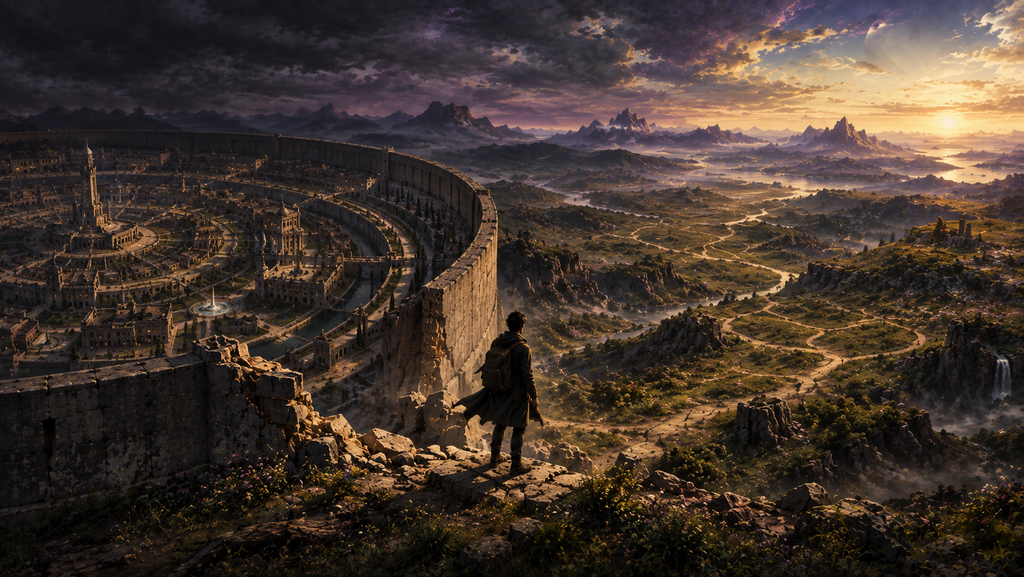
The first heretic may be condemned by the system he disrupts. The second generation may study him. The third may build upon him. The fourth may turn his rebellion into a rule. And then, eventually, another heretic appears. The cycle begins anew.
The heretic is not necessarily the villain, nor the hero.
The heretic is the interruption. The door that was never supposed to be opened. And sometimes, opening that door is precisely how the next world begins.
“The Heretic Paradox: a system needs rules to exist, and disruption will eventually break those rules for it to become something else. He may be reviled by a generation, and revered by the next. But the Heretic is the necessary motion for the wheel of progress.“