
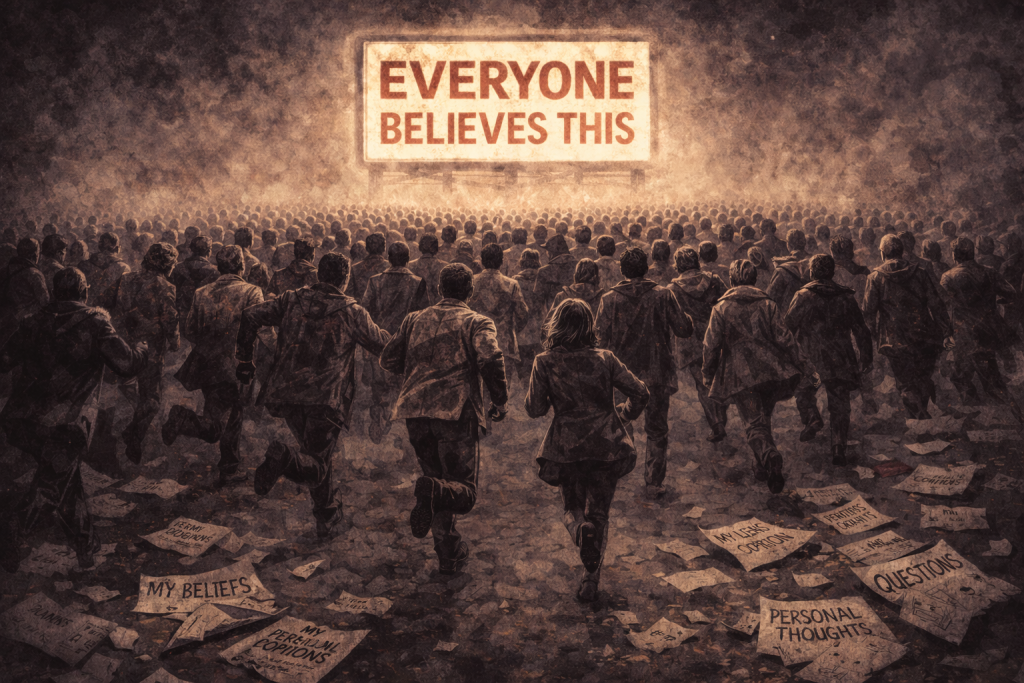
5 Propaganda Techniques Silently Influencing The Masses
Propaganda is everywhere. The mindless ride it, the woke notice it, and the conscious avert it. It is usually associated with governments as a tool for mass control, but it can also come from corporate marketing, news sources, and even religious institutions. The Iraq war would never have been an easy execution if it wasn’t riding on the terror war bandwagon. Likewise, governments and news sources have manipulated the masses slowly, readying them to vote yes for wars. Propaganda changes public opinions slowly, rallying their support for activities that would raise flags if done blatantly. Public opinion matters, and the shift to unreasonable ideology isn’t usually noticed. Here are 5 of those propaganda techniques that slowly shift public opinion silently. It’ll help you spot them, raising your awareness, and weakening their effect. What is Propaganda? Propaganda is an orchestrated manipulation system used deliberately to instill ideas, thoughts or beliefs into the psyche of the masses. It uses techniques borrowed from human psychology to embed ideas into the mind without resistance. Initially “Propaganda” is derived from the word “Propagation” which comes from the Latin word “Propagare”, roughly meaning “to spread.” However, the word we’re concerned with comes from the New Latin word Propaganda, which is short for “Congregatio de Propaganda Fide,” which translates to “Congregation for Propagating the Faith.” Initially, it was used by Pope Gregory XV to spread Catholic faith in 1622. By the 19th century, it was used politically to lessen the spread of ideas by calling them out as “Propaganda.” By the start of WWI, Propaganda was already known as a biased effort to change public opinions through misleading information. Since then, the word has mostly been used negatively to show mind control strategies used by governments. It’s certainly not limited to governments, and certainly doesn’t include coercion or force, it isn’t direct mind control either. Take a look at these propaganda techniques, and perhaps you’ll arrive at a better conclusion suited to your understanding. Five Propaganda Techniques Silently Shaping Public Opinion Here are five commonly used propaganda techniques designed to change public opinion covertly, and slowly. Once you know them, spotting them will be simple, and avoiding them, only a matter of action. 1. Repetition Repetition is the simplest persuasion trick in the book. If a message is repeated , it slowly becomes familiar, and familiarity starts feeling like truth. People stop asking whether it’s accurate and start recognizing it as something they’ve heard before. Once a phrase settles into public vocabulary, it becomes incredibly hard to dislodge. A classic example happened during the 2016 U.S. presidential election. The phrase “Drain the Swamp” was repeated constantly in speeches, rallies, and media coverage by Donald Trump. The message implied that government institutions were corrupt and needed cleaning. Whether people agreed or disagreed with the claim, the constant repetition embedded the phrase into political conversation and helped frame how many voters thought about Washington politics. Psychologists call this the Illusory Truth Effect, first demonstrated in 1977 by researchers Lynn Hasher, David Goldstein, and Thomas Toppino. Their experiments showed that people rated repeated statements as more believable than new ones, even when they knew the information might be false. 2. Emotional Framing Emotional framing works by hitting the heart before the brain has time to analyze the details. Messages are crafted to trigger strong reactions like fear, pride, outrage, or empathy. Once emotion is activated, people become more receptive to the narrative attached to it. Facts may still be present, but emotion becomes the entry point. A well-known case appeared after the September 11 attacks in 2001. Political messaging around the “War on Terror” used powerful emotional framing centered on fear, security, and national unity. Leaders like George W. Bush repeatedly framed the conflict as a defense of freedom against terrorism. The emotional intensity surrounding the attacks helped build widespread public support for the following military action against several sovereign states. This technique, derived from Affect Heuristic, a psychological concept studied extensively by Paul Slovic in the 1980s and 1990s. His research showed that people often rely on emotional impressions rather than analytical reasoning when judging risks and decisions. If something feels right or dangerous, the brain registers that feeling as evidence. 3. Borrowed Credibility (Authority Signaling) Borrowed credibility happens when a message uses authority to gain trust. If a statement comes from a respected expert, institution, or public figure, people tend to accept it more easily. Sometimes the authority is legitimate. But in the case of propaganda, it’s simply used as a signal to make a message appear more trustworthy. My favorite example of this comes from the MSG scare in the United States, and around the world. In 1968, a short letter published in the New England Journal of Medicine suggested headaches and numbness after eating Chinese food, coining the phrase “Chinese Restaurant Syndrome.” Media outlets repeated it, turning it into an international food myth despite FDA finding no solid evidence. And I love MSG, never caused me any harm. This effect was famously demonstrated in 1961 by social psychologist Stanley Milgram. In the Milgram obedience experiments, participants were willing to administer what they believed were dangerous electric shocks simply because an authority figure instructed them to continue. The study showed how humans capitulated to perceived authority. 4. Bandwagon Pressure Bandwagon pressure works by suggesting that an idea is already widely accepted. Humans naturally prefer to align with the group rather than stand alone. When a message implies that “everyone else already agrees,” people feel subtle pressure to adopt the same view. You could call it peer pressure as well, but that’s on a more personal level. This effect was observed during the 2017 social media explosion of the hashtag #MeToo, popularized by Tarana Burke and amplified globally after allegations against Harvey Weinstein. As millions of people posted the hashtag, the movement rapidly created a sense of collective momentum. The bandwagon effect encouraged more people to share their experiences, but most joined in because everyone else was