

Marketing on social media has become the primary marketing front line for businesses. While most brands are going insanely viral, the ones trailing behind are usually missing strategy. The first step is knowing your business needs a better social media presence. The next step is using it correctly.
This read will save you time and money. There’s a lot businesses can do with this powerful marketing tool, but there needs to be clear objectives rather than posting to join the algos.
Here are 13 objectives that business owners can accomplish using Social Media Marketing, followed by strategies, tactics, and measurements for success.
13 Social Media Objectives & Strategies for Business Owners
There were an estimated 5.79 billion social media user identities worldwide as of April 2026, representing more than two-thirds of the world’s population. In Bangladesh alone, DataReportal counted 60 million active social media user identities in January 2025, equivalent to 77.1% of the country’s internet users.
DataReportal found that half of adult internet users visit social platforms specifically to learn about brands and the content they publish.
That creates an insanely large audience for businesses to create their impact. How you create your impact depends on these 13 objectives with strategies, tactics and measurements.
1. Audience Growth
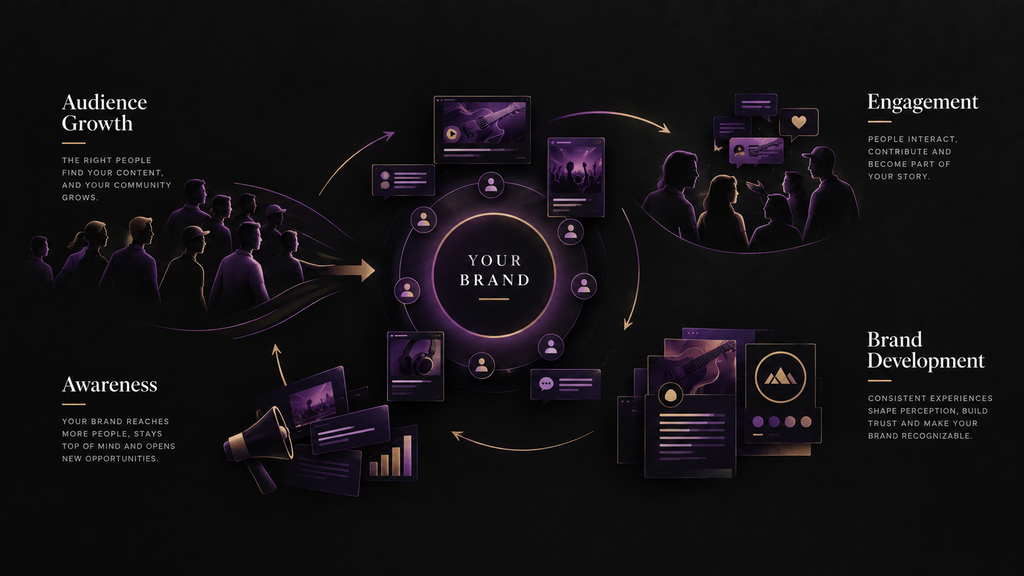
Objective
Attract new people who could eventually become customers, advocates, employees or members of your community.
Audience growth is about expanding your pool of relevant people, not collecting followers for the sake of a bigger number.
A business selling musical instruments, for example, doesn’t necessarily need 100,000 random followers. It needs musicians, music enthusiasts, aspiring musicians and people who are likely to buy or recommend musical products.
Social media gives businesses access to enormous audiences, but reach without relevance can become an expensive vanity metric.
DataReportal’s research shows that social media ads are already one of the world’s leading sources of brand discovery, with 29.7% of internet users surveyed identifying them as a source for discovering brands and products.
Strategy
Build a repeatable content system designed around the interests, problems and behaviours of the target audience, not around the products the company wants to sell.
The goal is to give the right people reasons to discover, follow and return to the account.
Tactics
- Educational and entertaining short-form video
- Shareable content
- Search-friendly social content
- Collaborations with relevant creators
- Community participation
- Trending topics where they genuinely fit
- Paid promotion of high-performing content
- Platform-specific content rather than identical cross-posting
Measurement
Track:
- Reach
- Follower growth
- Non-follower reach
- Profile visits
- Follower conversion rate
- Audience demographics
- Audience relevance
- Cost per acquired follower, where paid promotion is used
Don’t judge audience growth solely by follower count. A smaller audience that consistently watches, shares, enquires and buys can be considerably more valuable than a huge passive audience.
2. Lead Generation & Sales
Objective
Turn social media attention into enquiries, leads, purchases, bookings or other valuable business actions.
This is where social media is used efficiently and strategically to generate revenue.
And there is good reason for businesses to take this seriously. HubSpot’s 2025 State of Sales research found that 35% of sales professionals identified social media as their top source of high-quality leads, while 45% rated social media as very effective at driving sales.
Strategy
Create content that identifies customer problems, demonstrates the company’s ability to solve them, builds confidence and gives interested prospects a clear next step.
The strategy should move people from attention to interest to action.
That doesn’t mean every post should push users to “BUY NOW.”
A potential customer may first discover your company through an educational post, later watch a product demonstration, then see a customer testimonial, visit your profile, and finally send a DM, contributing to several stages of the buying journey.
Tactics
- Product demonstrations
- Case studies
- Testimonials
- Educational content
- Problem/solution posts
- Offers and promotions
- Lead magnets
- Landing pages
- Lead-generation forms
- Direct-message CTAs
- Retargeting campaigns
- Social commerce
- Sales-team follow-up through social
Measurement
Track:
- Leads generated
- Qualified leads
- Enquiries
- Conversion rate
- Purchases
- Revenue attributed to social
- Cost per lead
- Customer acquisition cost
- Return on ad spend
- Lead-to-customer rate
If a reel gets 100,000 views, track what happens after those 100,000 views.
3. Audience Engagement & Community Building
Objective
Turn an audience into an active community that interacts with, talks about and participates in the brand.
A follower is passive, but a community participates in your brand.
This is particularly important because social media is fundamentally a two-way environment. Sprout Social’s research found that consumers want brands to interact meaningfully with them, while its 2025 research also emphasizes that community engagement is becoming increasingly important to trust and business outcomes.
Strategy
Create recurring opportunities for people to participate rather than using social media as a broadcasting channel.
The brand should become part of the conversation rather than simply announcing things to an audience with subversive CTAs.
For a music company, this could mean asking musicians to share their setups, running playing challenges, featuring customer performances or creating recurring community sessions.
Tactics
- Questions and conversation starters
- Polls
- Q&As
- Challenges
- User-generated content
- Contests
- Community groups
- Customer features
- Comment responses
- Live sessions
- Behind-the-scenes content
- Recurring community series
Measurement
Track:
- Comments
- Shares
- Saves
- Replies
- Mentions
- User-generated content
- Participation rate
- Returning participants
- Community growth
- Sentiment
- Engagement rate
And remember that engagement quality is far more valuable than engagement volume.
A hundred people arguing about your post is technically engagement. It isn’t necessarily the community that would help the entire roadmap.
4. Brand Development & Awareness
Objective
Make the business recognizable, distinctive and memorable, while shaping audience perception.
Branding is one of the easiest social-media objectives to misunderstand.
A business can have excellent products and still be forgettable.
Social media gives the company a public space to repeatedly communicate its personality, values, positioning, visual identity and point of view.
DataReportal found that people discover brands through an average of 5.8 different sources, with social media advertising among the major discovery channels.
That means social media doesn’t exist in isolation. Someone may encounter your brand on Instagram, hear about it from a friend, search for it on Google, visit your website and eventually walk into your store.
Strategy
Develop a consistent brand narrative and recognizable identity, then reinforce it through repeated exposure across relevant content and channels.
The objective is to make the business feel like the same business wherever people encounter it. Brand identity across all channels need to align on all levels, and move in unison.
Tactics
- Brand storytelling
- Consistent visual identity
- Distinctive tone of voice
- Founder/executive content
- Behind-the-scenes material
- Customer stories
- Brand campaigns
- Cultural participation
- Signature content series
- Product storytelling
- Community involvement
Measurement
Track:
- Reach
- Impressions
- Branded searches
- Profile visits
- Direct traffic
- Share of voice
- Brand mentions
- Sentiment
- Brand recall or awareness surveys
- Growth in branded enquiries
For brand development, immediate sales are not always the right yardstick. You are building an asset that can influence future decisions.
5. Customer Retention & Loyalty
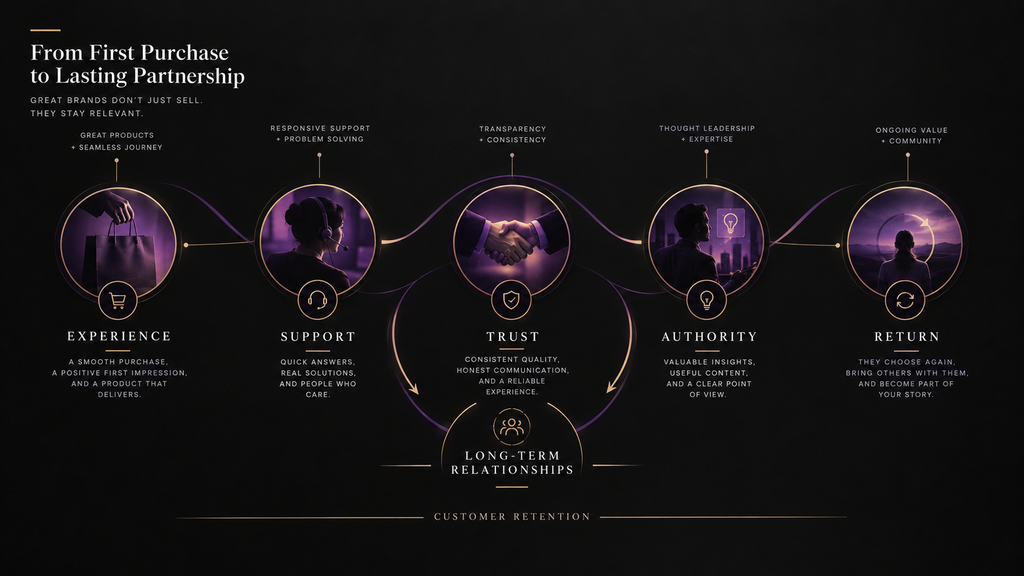
Objective
Keep existing customers connected to the business and give them reasons to return.
Acquiring a customer is considered an important strategy. Keeping them stuck to your brand requires a different strategy altogether.
If someone has already bought from you, social media can help maintain the relationship long after the transaction.
This can be especially valuable for businesses where repeat purchases, upgrades, referrals or memberships are the main objectives.
Sprout Social’s research found that 58% of marketing leaders say social media drives customer loyalty for their companies.
Strategy
Use social media to continuously provide value to existing customers, recognize them, support them and keep the brand relevant between purchases.
The customer should continue to feel like part of the brand’s world after the sale. And this isn’t difficult to pull off. Some brands enjoying insane loyal customers are employing specific tactics to keep them on board.
Tactics
- Customer-exclusive content
- Product tips
- Tutorials
- Customer spotlights
- Loyalty offers
- Early-access announcements
- New-product previews
- Community groups
- User-generated content
- Personalized responses
- Referral campaigns
- Customer appreciation campaigns
Measurement
Track:
- Repeat purchase rate
- Customer lifetime value
- Referral rate
- Returning customers
- Engagement from existing customers
- UGC from customers
- Loyalty-program participation
- Churn
- Customer sentiment
The social-media team should also work with sales and customer-service teams here. Loyalty is a business outcome, not merely a social-media metric.
6. Thought Leadership & Industry Authority
Objective
Establish the company or its people as credible sources of expertise and useful ideas.
This is particularly valuable for B2B companies, professional services, consultants, technology companies and businesses selling complex products.
Audiences usually seek evidence that you understand their problem better than your competitors do.
The Edelman-LinkedIn B2B Thought Leadership Impact research found that 73% of B2B decision-makers consider thought leadership a more trustworthy basis for assessing an organization’s capabilities than marketing materials and product sheets.
Strategy
Publish original insights, useful analysis, strong opinions and practical expertise around the problems your target audience actually cares about.
Good thought leadership should teach people vital skills and insights, change how they think or help them make a better decision.
Tactics
- Expert commentary
- Industry analysis
- Original research
- Data interpretation
- Executive posts
- Educational videos
- Case studies
- Whitepapers
- Webinars
- Opinion pieces
- Industry predictions
- Expert interviews
Quality is enormously important here. LinkedIn’s summary of the Edelman research notes that only 15% of surveyed buyers considered the thought leadership they encountered to be very good or excellent. Strong research, useful guidance and concrete examples were among the characteristics associated with higher-quality work.
Measurement
Track:
- Qualified audience growth
- Mentions by industry figures
- Shares by relevant professionals
- Speaking invitations
- Media opportunities
- Inbound enquiries
- Sales conversations influenced
- Content-assisted pipeline
- Brand perception
- Direct traffic from thought-leadership content
I wouldn’t recommend business owners to measure authority by follower count alone.
Being followed by 50,000 irrelevant people does not make you an industry authority, but being referenced by 20 people who actually influence your industry might.
7. Customer Support & Relationship Management
Objective
Help customers where they already communicate with the business.
For many customers, sending a DM or commenting on a company’s post is easier than finding a support email address, filling out a form or sitting on hold.
That makes social media part of the customer-service environment.
Sprout Social’s 2025 research found that 73% of consumers agree that if a brand doesn’t respond to them on social, they will buy from a competitor. It also found that 73% expect a response within 24 hours or sooner.
Strategy
Build a responsive social customer-care system with clear response standards, escalation procedures and access to the information required to resolve common problems.
This means social media management needs coordination with customer service, sales and operations.
Tactics
- DM support
- Comment responses
- FAQs
- Troubleshooting content
- Product education
- Saved replies
- Escalation procedures
- Service announcements
- Support-focused highlights
- Customer feedback collection
- Social listening
Measurement
Track:
- Response time
- Resolution time
- Resolution rate
- Customer satisfaction
- Number of support requests
- Escalations
- Repeat complaints
- Sentiment
- Retention after support interactions
A social-media manager shouldn’t be expected to magically solve an operational problem the company hasn’t solved internally.
Social can reveal the problem.
The business still has to fix it.
8. Reputation Management
Objective
Understand and influence how the public perceives the business.
The way audiences perceive your brand is shaped by what customers say about you rather than what you post or publish.
That includes comments, reviews, mentions, complaints, recommendations and conversations happening outside your own pages.
BrightLocal’s 2026 Local Consumer Review Survey found that 97% of consumers read online reviews for local businesses, while 85% said positive reviews make them more likely to use a business and 77% said negative reviews make them less likely to choose one.
Strategy
Monitor conversations about the company, respond constructively, amplify credible positive experiences and use recurring complaints as signals for operational improvement.
Your page will get plenty of negative comments, complaints, and ramblings. Deleting them might tank your reputation even more. Handling this with a stoic mind, with the ulterior motive to solve issues will elevate the status of your brand.
Tactics
- Social listening
- Review monitoring
- Responding to reviews
- Complaint-response protocols
- Crisis communication
- Customer testimonials
- Case studies
- Positive customer stories
- Employee advocacy
- Transparency content
Measurement
Track:
- Brand sentiment
- Positive vs. negative mentions
- Review volume
- Review rating
- Response rate
- Response time
- Complaint resolution
- Share of voice
- Brand mentions
- Changes in sentiment over time
Handling online reputation and improving brand perception can be difficult with negative comments, but deleting them will make the situation much worse. The best practice is to track complaints over time.
If a recurring complaint is noticed, the brand is advised to take action to rectify the situation rather than silence the voices.
9. Website Traffic & Content Distribution
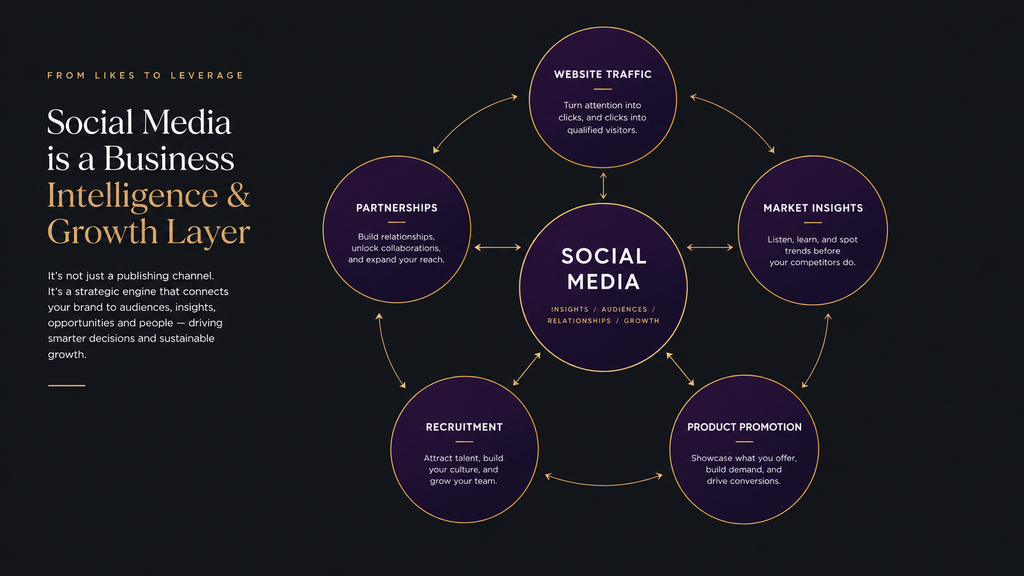
Objective
Use social media to move people toward your owned digital properties.
Social platforms are useful, but your company doesn’t own them. Your website, email list, blog, resource library and customer database are different assets owned by your business.
Social media can act as the distribution layer that introduces people to those owned channels.
DataReportal’s research shows that brand websites remain one of the major sources people use to discover products and brands, while social platforms increasingly participate in the same discovery journey.
Strategy
Create valuable content on owned platforms and use social media to distribute, contextualize and repurpose that content for relevant audiences.
Instead of posting “New blog! Click here,” extract the useful idea from the article and make the social post valuable by itself.
Then give interested people a reason to continue to the website.
Tactics
- Blog promotion
- Article excerpts
- Educational carousels
- Video summaries
- Newsletter promotion
- Landing-page campaigns
- Lead magnets
- Product-page promotion
- Case-study distribution
- UTM tracking
- Retargeting
Measurement
Track:
- Social referral traffic
- Link clicks
- Click-through rate
- Landing-page sessions
- Time on page
- Sign-ups
- Downloads
- Leads
- Purchases
- Conversion rate
Traffic is not automatically valuable unless it performs a useful action.
10. Market Research & Customer Insights
Objective
Use social media to learn what customers actually think, want, dislike, discuss and need.
This is one of the most underused functions of social media. Every comment, question, complaint, comparison, review, mention and discussion can contain information about the market.
Sprout Social’s 2026 Social Intelligence research found that 86% of professionals believe their organizations may have missed opportunities because social insights were delayed, siloed or underused. Only 36% said social data currently informs decisions outside marketing on a regular basis.
That is a giant missed opportunity.
Strategy
Use social media as a continuous source of customer and market intelligence, then feed those insights back into marketing, product development, sales and customer experience.
The goal is to identify patterns, and the marketing department has the ultimate research tool at their disposal.
Tactics
- Social listening
- Competitor monitoring
- Polls
- Surveys
- Comment analysis
- Review analysis
- Customer interviews
- Trend monitoring
- Search-query analysis
- Product feedback
- Sentiment analysis
- Audience segmentation
Sprout’s research specifically identifies opportunities such as discovering customer pain points, identifying trends, understanding competitors and finding messages that resonate with audiences.
Measurement
Track:
- Number of actionable insights
- Customer pain points identified
- Product improvements informed by social
- Emerging trends identified
- Competitor insights
- Sentiment shifts
- Message performance
- New audience segments discovered
- Revenue or product decisions influenced by insights
The best social-media report may occasionally contain a sentence that has nothing to do with likes:
“Customers keep asking for this.”
That can be more valuable than a million impressions.
11. Product & Service Promotion
Objective
Increase awareness, understanding and demand for specific products, services, offers or launches.
Businesses obviously need to sell things.
The problem is that if every post is a sales pitch, people eventually stop paying attention.
Product promotion works better when the audience understands why they would buy the product, not merely what the product is.
Social platforms are increasingly part of product discovery and purchasing. For example, TikTok’s own research reports that 61% of its users discover new brands and products on the platform, while its commerce research found that 62% of users follow links on TikTok to discover products on brand websites.
Strategy
Demonstrate the product in context, connect features to customer problems and combine promotional content with education, proof and real-world use cases.
Instead of:
“Our new microphone has Feature X.”
Show:
“Here’s the problem musicians have when recording X, and here’s how this microphone handles it.”
Tactics
- Product demonstrations
- Tutorials
- Before-and-after content
- Comparisons
- Customer testimonials
- Use cases
- Product launches
- Offers
- Limited-time promotions
- Unboxings
- FAQs
- Creator content
- User-generated content
- Live shopping
Measurement
Track:
- Product-page visits
- Product enquiries
- Add-to-cart actions
- Purchases
- Conversion rate
- Revenue
- Sales attributed to campaigns
- Coupon/code usage
- Cost per acquisition
- Return on ad spend
The important cue is whether the strategy moved people closer to buying. Considerably becoming a part of the buying journey rather than the deal sealer.
12. Recruitment & Employer Branding
Objective
Attract people who want to work for the company and show potential candidates what working there is actually like.
Your social media routinely reaches out to potential employees who are watching every post. Employer branding is essentially the company’s public reputation as a place to work.
LinkedIn’s 2025 candidate research, based on more than 73,000 responses, found that compensation and benefits were the top priority for 63% of candidates, followed by work-life balance at 49% and flexible work arrangements at 44%.
That gives businesses a useful lesson: employer branding should communicate things candidates genuinely care about rather than simply posting “We’re hiring!”
Strategy
Show the reality of the organization through employee stories, workplace culture, leadership, opportunities and evidence of what employees actually experience.
The strategy should be authentic.
If the social account says “We’re a family” while employees privately describe the company as a nightmare, the internet will eventually discover the plot twist.
LinkedIn recommends using employee stories, behind-the-scenes content, testimonials and employee achievements to communicate employer brand.
Tactics
- Employee stories
- Behind-the-scenes content
- Workplace culture
- Employee achievements
- Leadership content
- Career-development stories
- Office events
- Job announcements
- Employee-generated content
- Recruitment videos
- Day-in-the-life content
- Company values
Measurement
Track:
- Qualified applicants
- Applications from social
- Source of hire
- Application conversion rate
- Cost per applicant
- Cost per hire
- Quality of hire
- Offer acceptance rate
- Time to fill
- Employee advocacy
- Employer-brand sentiment
The goal is to make the company accurately attractive to the right people for employment. Painting the wrong picture for future hires will usually work against the strategy.
13. Partnerships, Influencers & Collaborations
Objective
Use other people’s credibility, expertise, audiences and communities to expand the reach and relevance of your brand.
A collaboration can put a company in front of people it would struggle to reach alone. But the biggest mistake is choosing a partner purely because they have a large follower count.
The better question is:
Do they have the right audience, the right credibility and the right relationship with that audience?
Creator marketing has become a significant business channel. CreatorIQ reported that average annual creator-marketing budgets increased 171% year over year in its 2025 research, while 71% of organizations increased their investment. Its research also shows a growing emphasis on measurable ROI, brand fit and longer-term relationships.
Strategy
Build partnerships with creators, experts, complementary businesses or communities whose audiences overlap meaningfully with your own.
The best collaborations create value for all three sides:
Brand + Partner + Audience.
Tactics
- Influencer partnerships
- Creator campaigns
- Affiliate partnerships
- Co-created content
- Joint events
- Podcasts
- Expert interviews
- Brand ambassadors
- Cross-promotions
- Giveaways
- Community partnerships
- User-generated content campaigns
- Long-term creator relationships
CreatorIQ’s research also suggests that creator partnerships are becoming less about one-off posts and more about scalable, measurable programs.
Measurement
Track:
- Reach
- Engagement
- New relevant followers
- Referral traffic
- Leads
- Sales
- Affiliate revenue
- Conversion rate
- Cost per acquisition
- Earned media value
- Audience quality
- Creator-specific ROI
It is recommended to measure the effect of the campaign rather than the numbers. A million views doesn’t necessarily mean higher conversions when it comes to creator marketing.
These Objectives Should Work Together
These might be separate objectives, but a social media campaign usually runs 3 or 4 of them as pillars. Content pillars are a whole different story, but in short, pillars are what we refer to as “executing tactics for set strategies”.
Imagine a guitar company launches a collaboration with a respected local guitarist.
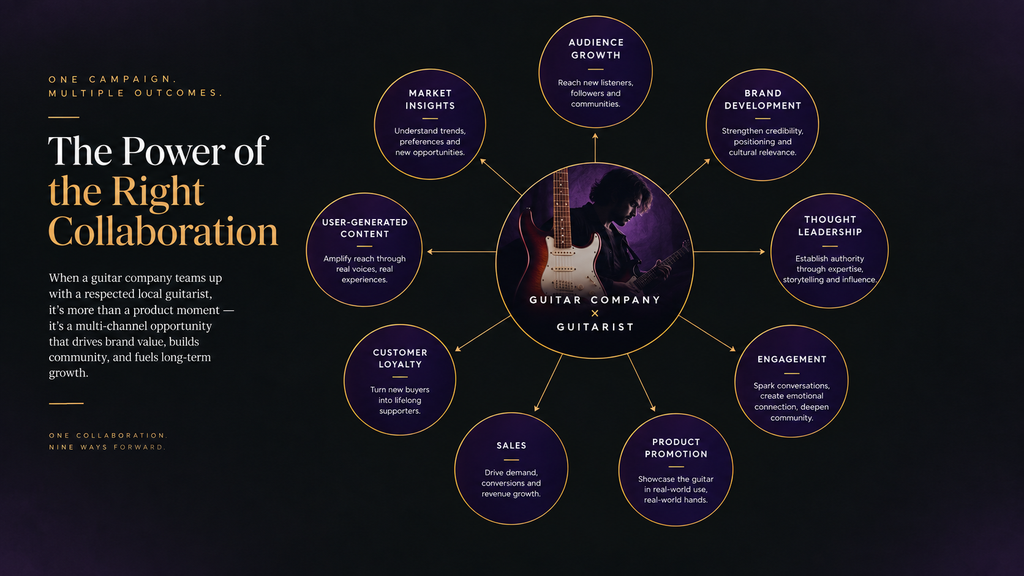
The campaign could:
- Grow the audience through the artist’s existing followers.
- Develop the brand by associating it with a particular musical identity.
- Build authority by featuring the artist’s expertise.
- Generate engagement through playing challenges.
- Promote products through demonstrations.
- Generate sales through a specific offer.
- Generate customer loyalty by involving existing customers.
- Create user-generated content through the community.
- Generate market insight by observing what products and content audiences respond to.
The tactic is the same. The objectives are different. Simply asking a social-media team to “make more reels and posts” is an incomplete instruction. A Reel could accomplish almost anything. The strategy determines why you’re making it.
Communicating Efficiently WIth The Social Media Team
I’ve been in enough situations to know what the team needs to hear to do their job right. Clear communication is the way business owners can push their objectives efficiently. Social media teams know what to do, they’re just waiting for the right orders.
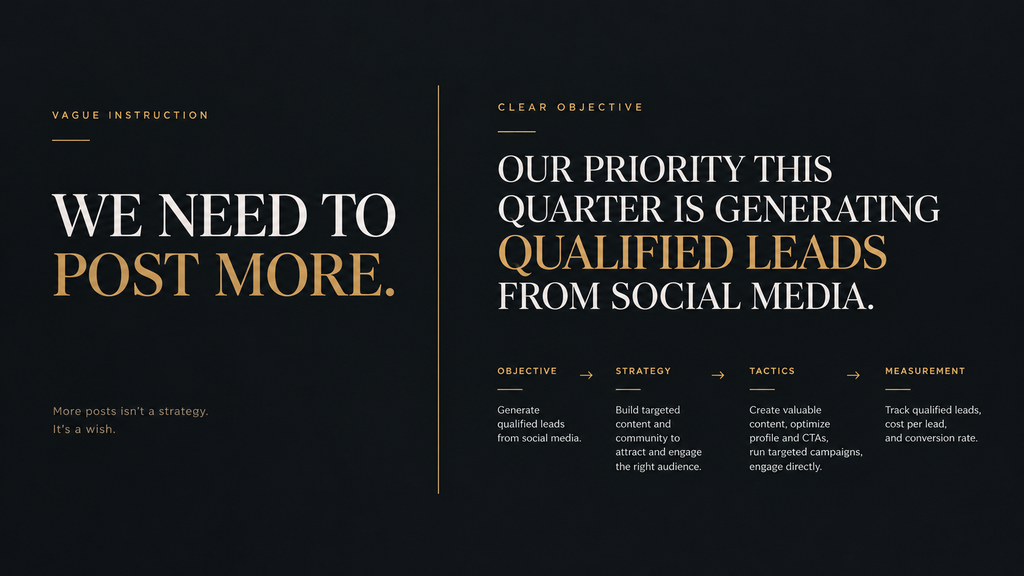
If you’ve familiarized with the objectives, now Instead of saying:
“We need to post more.”
Try phrasing the delegation this way:
“Our priority this quarter is generating qualified leads from social media. Build a strategy around that objective, decide which content and platforms are most appropriate, and report back on the metrics that show whether we’re getting closer to the goal.”
Or:
“We want to increase customer retention. Show me how social media can help existing customers get more value from our products, stay engaged with the brand and come back to us.”
Or:
“We’re entering a new market. Our priority is brand awareness among this particular audience. What strategy will introduce us to them and establish credibility?”
That changes the entire conversation. The social-media team will have solid objectives to work on. They can research the audience, choose content formats, and decide which platforms would work best. With that, they can build campaigns, test ideas, measure results, and change the strategy when the data suggests something isn’t working.
And most importantly, they can explain why they’re doing what they’re doing.
Know Your Objective & Push Your Strategies
Now that you have the knowledge of the business objectives you can push using Social Media Marketing, time to get right ahead and create that impact. Remember, your brand’s story is always unfolding, but you’ve gotta keep adding more episodes.
Keep in mind, objectives are what strategies accomplish. Strategies themselves need tactics to accomplish. Measurements make sure the tactics are being executed right.
Communicate effectively with teams, and delegate the objectives to them through clear words. A team that’s led right will do the work right.
Bookmark this page to take notes about social media strategies.
Or
Read about the common mistakes that tank your rank in Social Media Marketing.