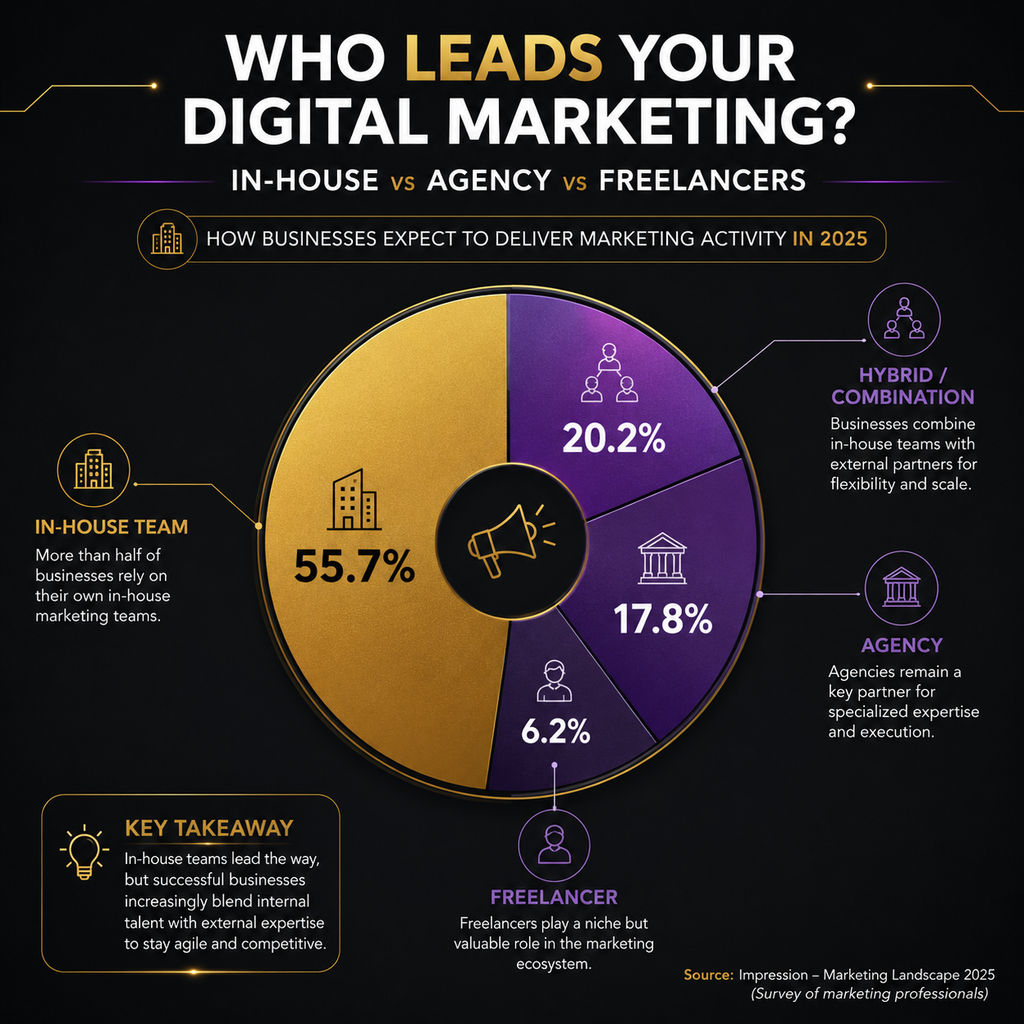
Digital Marketing is fueling growth at an exponential rate, and so are the businesses adopting change. Businesses seeking growth are need to make one simple decision.
How are they gonna do it? Which is the best pick?
There are three distinct paths to Digital Marketing with their own set of perks and drawbacks, followed by a logical grounds of comparison and contrast for better decision-making.
- In-House Employees – Hired for the sole purpose of digital marketing.
- Agencies – Digital Marketing outsourced to an a full offshore team.
- Freelancers – Commissioned professionals with a unique or combined skillset.
This trio leads digital marketing for all businesses across all platforms. Sure, some business owners may choose to do it themselves, diverting their attention into Marketing. However, these outliers usually move slower than usual.
A business runs smoothly when time and attention are spent behind.
- Planning
- Execution
- Strategizing
- Communications
- Delegation
- Analysis
- Documenting
And these are just what business owners need to do themselves. If they had to spend those hours
- Designing a marketing plan for their brand and product
- Creating individual campaign roadmaps
- Creating Marketing Material (this one is more complex)
- Distributing the materials (or content) accordingly
- Communicating with top funnel leads
- Analyzing the effectiveness of each campaign
- Making contingency/fall back plans for campaigns
You’ll hire marketing professionals eventually, this article will help you decide.
- Understand the path with the lowest cost
- Pick the path with the highest effectiveness
- Ascertain which path will align with your business objectives
- Decide which skills you need on-board
- Understand if digital marketers also know the foundations of traditional marketing
- and ultimately pick the right digital marketing path for your business.
This article comes with insights from professionals who’ve worked all three paths, with clear understanding on how they work across industries.
Of Course Your Business Needs Marketing
At it’s core, Marketing is all about how you position your product or service, allowing those who need it, to come get it. It’s as easy as
Choosing the
- Product (or service) to sell
- Price to sell at
- Place to sell from
- People to sell to
- and the Promotion to get the word out
Digital Marketing tackles these basics quite easily, but their main selling point is the channel of distribution for promotion and communicating with leads (sales).
- Through Facebook statics, reels & ads
- Reels & Statics on Instagram
- Reels on Tiktok
- Promotional & Ecommerce listings on your Website
- Discussions on Reddit
- Or Long-form Videos on YouTube
That’s 98% of basic digital marketing.
However, Digital Marketing doesn’t necessarily cover your traditional Marketing department, since most decisions are based on product positioning and priority. It’s just usually the execution on the broader scale for these specialists.
But as a business owner, I’d suggest understanding the distinction between Marketing & Digital Marketing before making a decision. This is where rushing in might cost you extra and throw your efforts back a few months.
Comparing The Three Digital Marketing Models – In-House vs Agency vs Freelancers
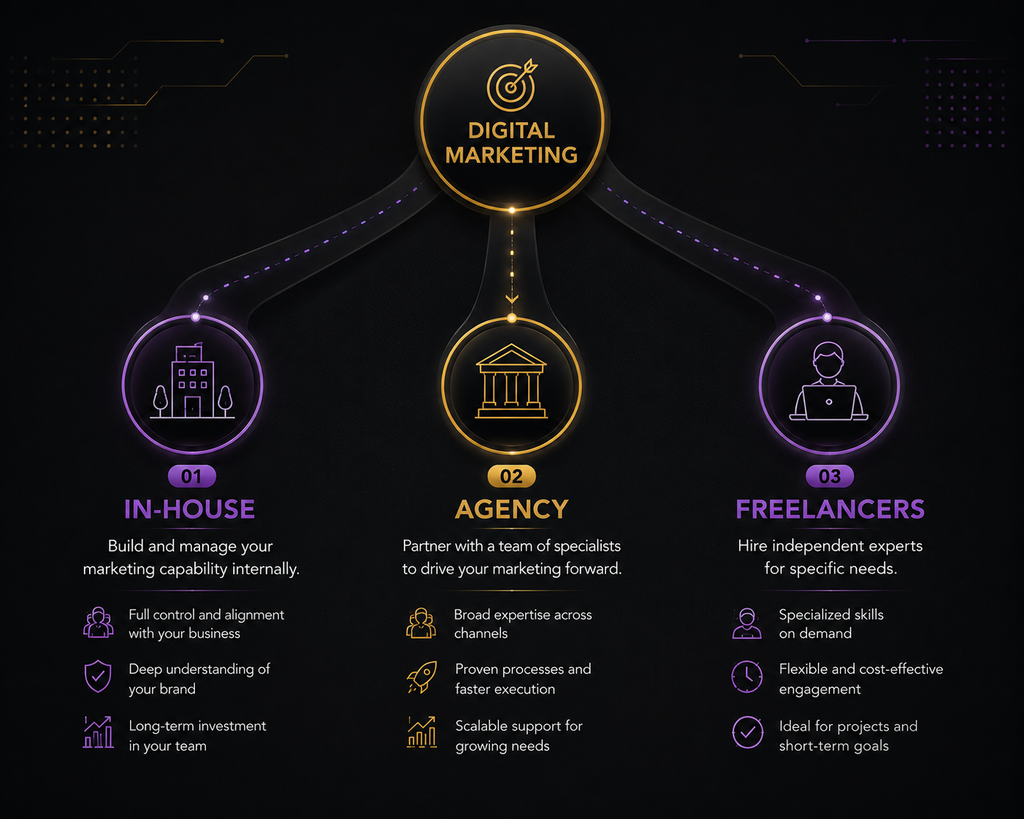
Since digital marketing is what your business needs, we’ll cut ahead to the three main sources.
- in-House Digital Marketing Executives
- Local or International Digital Marketing Agencies
- Local or International Digital Marketing Freelancers.
There’s no “one path suits all” here. An ecommerce-first business might benefit more from Freelancers, than a Multi-National Tech Company, which needs an In-House Digital Marketing team under direct control for swifter delegation and turnaround.
It’s about more than just scaling, or cost effectiveness, as will be revealed up ahead.
In-house Marketing
Your marketing is handled inside your organization.
That might mean one marketing executive handling everything, or a larger department containing specialists in content, SEO, paid media, design, social media, analytics and other disciplines.
The people responsible for marketing are part of the organization making the business decisions. And this is where organizations have full control of their digital marketing.
Agency Marketing
You hire an external company to provide marketing services based on requirements.
An agency may offer a single specialty or an entire system of interconnected services. Depending on the agency, you might get strategists, designers, copywriters, media buyers, SEO specialists, developers, analysts and account managers under one roof.
The major advantage of agency marketing is having an external infrastructure.
You gain access to a team without having to build that team yourself. No office space required, no equipment whatsoever.
Freelance Marketing
You hire an independent professional to perform specific work or provide a specific capability.
That might be a copywriter, SEO specialist, designer, paid-media specialist, videographer, strategist, developer or someone capable of wearing several of those hats at once.
This gives business organizations individual flexibility.
You can buy a particular skill without committing to an entire team.
None of these is inherently superior.
Each solves a different organizational problem.
Every Path Has a Trade-Off
Each path gives you one advantage while taking another away. Each also has it’s own limits.
In-house gives you proximity and control, but requires investment in people and infrastructure.
Agencies give you breadth and specialist expertise, but introduce distance between the people doing the work and the business itself.
Freelancers give you flexibility and low commitment, but that flexibility can come at the expense of continuity and breadth.
The bigger question to answer here is,
What does your business need most?
That’s where the comparison begins.
The Basis of Comparison – In-House vs Agency vs Freelancers
A business that needs specialist expertise more than control will reach a different conclusion from one that needs marketing embedded into its daily operations. The following table ascertains each factor for the three paths.
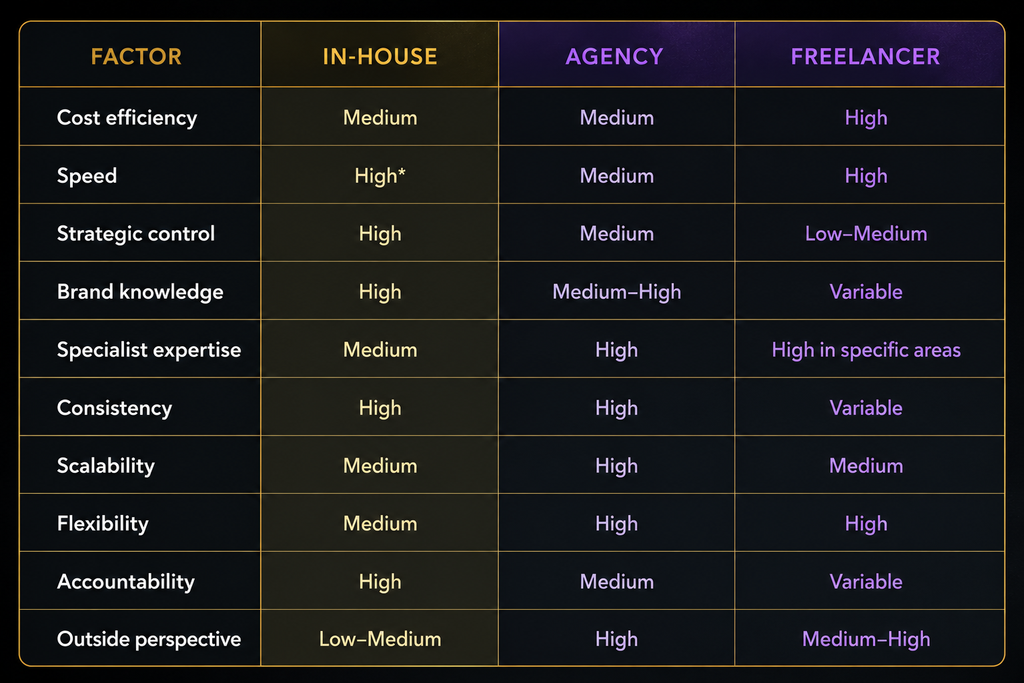
*Assuming the internal organization can make decisions quickly.
This table tells you what each path is optimized for.
In-house optimizes for ownership.
Agencies optimize for breadth and external capacity.
Freelancers optimize for flexibility and specific expertise.
Once you understand that, the decision becomes much easier.
The Failure Test
The best way to understand any path is to ask where it breaks and hits the limit.
In-house fails when…
Leadership doesn’t know what it wants marketing to accomplish.
A company hires a marketer, gives them access to social media, tells them to “increase sales,” and expects strategy to emerge from the void.
It usually doesn’t.
In-house teams can also stagnate when they become too isolated. A team exposed to only one business, one industry and one set of assumptions can eventually stop questioning those assumptions.
The very proximity that creates alignment can create an echo chamber.
Agencies fail when…
The business needs constant speed, nuance and proximity.
Agencies are designed to serve multiple clients. That is both their strength and their structural limitation.
If every decision requires context that takes twenty minutes to explain, an agency can become expensive in ways that don’t appear on the invoice.
Agencies can also fail when they sell execution without meaningful strategic depth.
If what you’re buying is essentially a collection of deliverables that an internal team or specialist could produce independently, the agency’s overhead may become difficult to justify.
Freelancers fail when…
The business needs broad capability, deep organizational integration or guaranteed capacity.
A freelancer can be extraordinary at one thing. But, that doesn’t make them an entire marketing department. They can also become a weak choice when continuity depends entirely on one person’s availability.
Your marketing stops if your freelancer gets sick, takes another client or disappears for two weeks.
The Business-Maturity Test
The right model has less to do with company size than people assume.
A small business can need an agency.
A large business can rely heavily on freelancers.
A five-person startup can have an internal marketing specialist.
The more useful question is:
What role does marketing play in the way your business operates?
Stage 1: “We need some marketing done.”
You have occasional needs.
A website.
A few articles.
Some social media content.
A launch campaign.
A video.
You don’t have enough continuous work to justify permanent capacity.
Freelancer is often the logical starting point.
Stage 2: “Marketing is becoming a regular function.”
You need content every week.
Your social channels require continuous management.
SEO is becoming important.
You are running campaigns regularly.
You need multiple skills, but you’re not ready to build an entire department.
An agency or a combination of freelancers can make sense.
Stage 3: “Marketing is part of how the business operates.”
Marketing interacts constantly with sales, product, customer service and leadership.
Customer feedback changes campaigns.
Product changes affect positioning.
Content is produced continuously.
Brand decisions happen every day.
At this point, marketing is an organizational function that needs assessment.
In-house becomes increasingly valuable.
Stage 4: “We need ownership, scale and specialist expertise.”
Now you’ve reached the point where pretending you have to choose one model is counterproductive.
You’re looking at a hybrid.
The Decision Matrix
So, where does that leave you?
If your business sounds like this:
“I need one specific skill for a defined project.”
Start with a freelancer.
“I need several marketing capabilities but don’t want to build a department.”
Consider an agency.
“I need marketing happening inside the business every day.”
Consider building in-house.
“I have an internal team but occasionally need specialist expertise.”
Add freelancers.
“I have an internal team but need external scale for major campaigns.”
Add an agency.
“I need strategy internally but can’t justify every specialist as a full-time employee.”
Persue a hybrid path.
“I don’t know what I actually need yet.”
This is the most important one.
Don’t hire anyone until you figure that out.
If you cannot explain what marketing is supposed to accomplish, the first problem is defining the marketing function.
The Self-Assessment Questions to Ask
Before choosing a path, answer these questions honestly.
1. How often do we need marketing work?
Occasionally?
Regularly?
Every day?
2. How predictable is that workload?
Is there a steady stream of work, or does demand arrive in bursts?
3. How many different skills do we need?
One specialist?
Several?
An entire multidisciplinary team?
4. How quickly do we need to make marketing decisions?
Can decisions wait several days?
Or do campaigns and customer conversations change by the hour?
5. How important is deep knowledge of our business?
Is marketing mostly a defined output?
Or does it need to interact with product, sales, operations and leadership?
6. Do we already have a marketing strategy?
If not, who is responsible for creating one?
7. How much management capacity do we have?
Someone has to manage the marketer.
An agency doesn’t eliminate management.
A freelancer doesn’t eliminate management.
An employee certainly doesn’t eliminate management.
Someone still has to decide what matters.
8. What happens if our marketing workload doubles tomorrow?
Can our current structure absorb it?
9. What expertise do we need that we don’t have?
And do we need that expertise permanently?
10. What matters more right now: ownership, breadth or flexibility?
If the answer is mostly ownership, build a marketing team in-house.
If it’s breadth, consider hiring an agency.
If it’s flexibility, commission freelancers.
If you need all three, you’re probably looking at a hybrid.
The Hybrid Path
This is where the three-way comparison eventually leads many mature businesses.
You don’t necessarily need to choose one.
You need to decide which parts of marketing should live where.
An internal team might own:
- Marketing strategy
- Brand direction
- Customer knowledge
- Day-to-day content
- Internal coordination
- Campaign priorities
- Performance oversight
A freelancer might provide:
- Specialist copywriting
- SEO
- Video editing
- Photography
- Design
- Development
- Other occasional specialist capabilities
An agency might provide:
- Large campaign execution
- Major paid-media operations
- International campaigns
- Specialized channel expertise
- Large-scale creative production
The internal team remains the strategic center.
External specialists extend its capabilities.
The agency becomes a source of scale rather than a substitute for organizational understanding.
That’s a proper business process architecture.
So Which One Should You Choose?
If you’ve made it this far hoping for a definitive answer, here’s the inconvenient truth:
The answer depends on your business needs.
A freelancer isn’t a cheaper agency.
An agency isn’t simply an outsourced marketing department.
An employee isn’t an agency without the monthly invoice.
Each path changes depending on how decisions move, how expertise is accessed and who carries responsibility for the outcome.
The best choice depends on the business.
If your marketing requirements are occasional and specialized, flexibility may matter most.
If you need broad expertise without building an entire department, an agency may make sense.
If marketing has become inseparable from your daily operations, internal ownership becomes increasingly valuable.
And if your requirements don’t fit neatly into one box, stop trying to force them into one.
Build a hybrid marketing team.
The Final Principle
The mistake is thinking you’re choosing who will do your marketing.
You’re actually deciding how marketing will operate inside your business.
Where will the knowledge exist?
Who will make the decisions?
How quickly can those decisions become action?
Who understands the customer?
Who owns the outcome?
Which skills need to exist permanently, and which can be brought in when needed?
Those are the questions that should determine your marketing structure.
Not the cheapest proposal.
Not the biggest agency.
Not the freelancer with the prettiest portfolio.
Not what your competitor is doing.
And certainly not whoever happens to promise that a few Meta campaigns will make your sales graph shoot vertically.
Marketing is a business function.
Digital marketing is one of the ways that function operates.
Choose the structure that matches the way your business actually thinks, decides and moves.
Because your marketing structure is just a part of your business operating system. It shouldn’t cause decision paralysis when hiring or scaling.
Or I could audit your business process to give you a step-by-step, ideation to analysis, goal-specific marketing roadmap. Or you can read about the 13 social media marketing objectives for businesses.