

If you’re a beginner guitarist, these few steps will help you tune right in, and start feeling the notes on the fretboard, across each string. I wouldn’t say it’s a one time training for a life-long lesson. The more you practice these techniques, they better they get and the longer you can keep them. Falling out of practice will dull your senses in every way.
So, let’s get you started on training your ear to sync with the notes on each fret, so you can play by ear without using tutorials, tabs, or sheet music.
Explaining “Play By Ear”

Playing by ear is the act of playing a succession of notes with the memory of each sound on an instrument without the help of notations, tabs, or tutorials.
It seems effortless how a performing guitarist always holds the right chords. It isn’t entirely memorizing, but very close. The trick is to hear a note, and instantly know where to find it on the fretboard. And that’s without memorizing the notes on each fret.
The eternal guitar master, Joe Satriani had one big tip for Steve Vai.
“Memorize all the notes on the neck, and don’t come back ’till you know all the notes”
To some, that is a daunting task, but, come on, that was Steve Vai! I will still back that claim, about knowing each note on the neck, and memorizing the sounds.
“Play by ear” is just one of the many skills that makes a good musician and ultimately a skilled guitarist.
If you’re looking for a short-cut, there are none. However, there are ways to tune that into your mind without actually memorizing the multitude of notes.
This is a beginner’s introduction to “playing by ear”, and this in itself will never replace the knowledge of music theory.
However, with deliberate practice, beginners can train their auditory nerves to hear a song, and instinctively play that on the guitar.
Here’s how.
The Easy and Fun Steps to Play By Ear
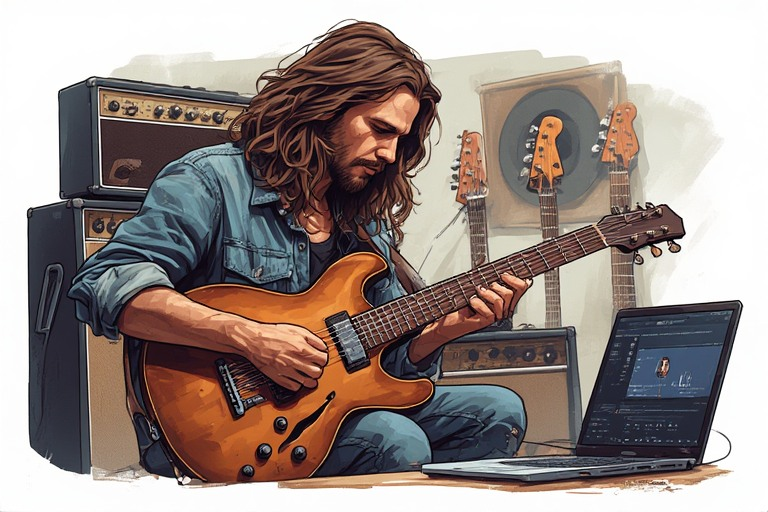
Alright, this is the part where I break down every little step that’ll help beginners naturally acquire the “play by ear” skill over time. Some are extremely useful, best not skip any of these. I am not asking you to play chromatic scales for an entire year, even though it will train your hand muscles.
These techniques will make you more of a natural than a shred-master. We’ll keep speed on second priority for now. You’re gonna have fun doing this, and once you get the hang of play-by-ear, there won’t be any song that you can’t figure out.
Step 1 – Love a Tune

We our reasons to start playing the guitar. To become like your guitar idol, to be able to play a song, and heck, even impress the ladies. No matter what your motivation is, if your end goal is to be a natural, you gotta love the tune, specifically a tune.
It could be a song, a tune, or an entire composition (you go virtuoso!). You gotta love it to be able to hum it. From there on, your fingers would want to play that on the guitar, imitate what’s being played right there.
Purely because you’ll try to imitate what you love, and later add to it.
Step 2- Know The Tune

Loving the tune is only the first step, this is what draws you attention. The next step is to know and understand each tune. Surely, you can notice the changing of notes.
Did they move up one fret, or perhaps down. If you know how that sounds on the guitar, you can sync that info with your mind later.
The way I like seeing this is, a little obstacle course. Perhaps even just a section of that obstacle course. Seeing each ascending and descending notes is what you gotta do. Visualize the section of the obstacle course.
Since this is a tune you love, you’ll sink right into it. On to the next step.
Step 3 – Finding the Notes

Sure, the fretboard is huge, but you got the time to pick the notes. Let me make it a bit simpler.
When you hear a section of a guitar solo or a simple intro, you can more easily tell which string it is played on. You don’t have to figure out 126 notes, maybe just 21.
21 frets can play pretty much all 12 notes plus 9 more. But hey, if you understand the string, set right on it.
Most intros and solos can be played on the 1E, 2B, and 3G strings. For now, try and find the notes, play every fret, hear what you’re playing, and when the key note matches, stay right there!
Move around the frets, and hum the notes when you pluck. The ear hears both your voice and the guitar’s tune. Your fingers and larynx will adjust the notes, helping you build the core knowledge to play by ear.
Why aren’t we using guitar tutorial sites?
Because the point is to figure it out on your own, or at least give it a shot. You can learn how to play hundreds of songs, but the point is to play one section with attention. These steps help train your neurons for music, and the more difficult it is, the better you learn. Now, let’s get back to the training. The next one’s a vital for levelling up your play by ear skill.
Step 4 – Play the tune

Sounds fairly simple once you know the rise and fall of the notes. You will aim short a fret or two sometimes, but the point is to try again, and get it right. You’ll miss the notes every other attempt, but remember the obstacle course, and map your route along the frets.
It helps remembering which fret you’re in, and which you’re moving to. Speaking them out will help you train the mind, muscle, and ear.
The bonus reward for beginner guitarists is seeing progress, and being able to play a tune. But that’s just the start.
Step 5 – Perfect & Repeat

See, you won’t always get it right. The more tries you put in, the more precise it gets. Playing the exact note being heard will light up a little bulb in your brain, every time.
Now, what you’re gonna want to do is, repeat this for other songs. And if you’re trying to play along with the track, and strumming the right chords, I’d suggest trial and error. Play all the chords you know while the song plays. Chances are, you’ll nail it.
However, this requires you to know a few beginner strengths. Let me explain.
Beginner’s Core Strengths
A guitarist climbs levels with practice. Beginners aren’t exactly far behind, they’re just starting off. You can consider yourself a beginner guitarist if you-
- Know the 7 basic majors and minors.
- Know the strings by name (E A D G B e)
- Know the progression of notes across the frets (A, A#, B, C, C# Etc)
- Know how to strum and pluck (if not with precision)
At this point, you’re getting a feel of the whole instrument, and I advise you to keep at it, because intermediate ain’t that far away.
The Bridge to the Intermediate Level

Here are a few things I recommend before you advance to intermediate, call it a bridge.
- Learn basic music theory
- Memorize notes until the 12th fret (shouldn’t be too difficult)
- Practice finger fluidity across strings and fets
- Alternate picking
- Learning and practicing different strums
- Learn how to tune a guitar without using a tuner
- Coordinate voice and guitar control.
That ain’t much, just a few steps ahead to build your way to the intermediate level. And this is with understanding, not speed. Give it time, there’s no rush, the more you play, the more you unlock possibilities of creating your own music.
And lastly, listen to music of every sort. The world has different cultures still untested to the fresh ear. Once you tune the mind, you too can play by ear.
Never Put Away The Guitar
And don’t let it sit in a corner gathering dust. There’s no limit to what you can do with this instrument. Gotta keep listening to new tracks, play the tunes you love, and do one extra run across the fretboard
. Once you spend enough time with your instrument, the music will come naturally, and you’ll unlock the “play by ear” skill.
Remember to follow the steps. It ain’t anything more that you trying to play your favorite tracks, and tuning your brain’s auditory sensors.
Stay connected with me, a guitarist trying to piece together the parts of a virtuoso. I’ve been playing for 25 years, battling cultures and beliefs to keep my craft. I’ll be putting out blogs for aspiring guitarists to help start their journey. Follow my page for random drops and tracks.
Keep playing folks!